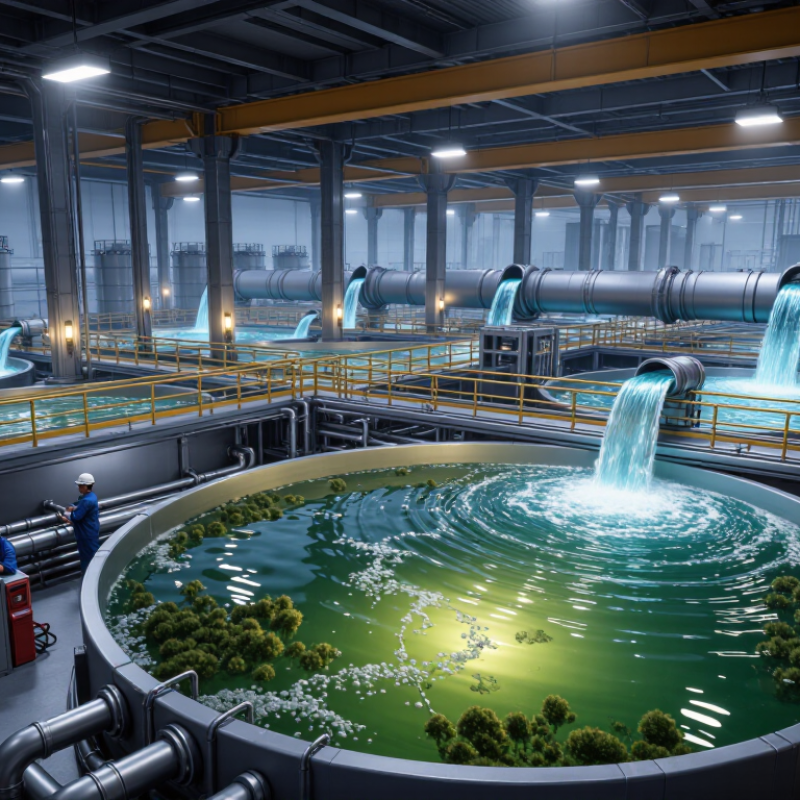
Activated sludge
Suspended-growth process | A mixed community of bacteria and other microorganisms consumes biodegradable material in aerated tanks. | Biodegradable organic matter, commonly measured as BOD₅ and COD | Biomass, carbon dioxide, water, and treated effluent; excess biomass is removed as sludge. | Requires aeration and management of dissolved oxygen, sludge age, and solids separation. |
Biofilm treatment
Attached-growth process | Microorganisms grow on a surface or carrier and use dissolved pollutants as they pass through the system. | Biodegradable organics; some configurations also support nitrification | Pollutant removal through microbial growth and conversion, with detached solids requiring separation. | Media and flow must be selected to limit clogging and maintain effective contact between wastewater and biofilm. |
Anaerobic treatment
Oxygen-free biological process | Communities of anaerobic microorganisms convert biodegradable organic matter through several stages, including methane formation. | Concentrated biodegradable organic wastewater and organic sludge | Biogas, mainly methane and carbon dioxide, plus stabilized residual biomass. | Does not require aeration, but needs suitable conditions such as temperature, pH, and protection from inhibitory compounds. |
Nitrification
Biological nitrogen conversion | Nitrifying microorganisms oxidize ammonia first to nitrite and then to nitrate under aerobic conditions. | Ammonia and ammonium nitrogen | Nitrate; nitrification changes nitrogen form but does not, by itself, remove total nitrogen. | Needs oxygen, sufficient alkalinity, and adequate microbial retention time; performance is sensitive to temperature and inhibitors. |
Denitrification
Anoxic biological nitrogen removal | Denitrifying bacteria use nitrate as an electron acceptor when dissolved oxygen is limited, typically using a biodegradable carbon source. | Nitrate and nitrite | Nitrogen gas, which leaves the water; this reduces total nitrogen when combined with nitrification. | Requires an anoxic zone and an available carbon source; excess oxygen can limit the process. |
| Enhanced biological phosphorus removal | Phosphorus-accumulating organisms take up and store phosphorus in biomass under alternating anaerobic and aerobic conditions. | Orthophosphate and other biologically available phosphorus | Phosphorus is removed from the water when phosphorus-rich biomass is wasted as sludge. | Needs suitable cycling conditions and readily biodegradable carbon; chemical polishing may be used where lower effluent phosphorus is required. |
| Industrial application fit | Treatment design selects and maintains microbial communities suited to the wastewater and required discharge or reuse goals. | Food-processing, pulp and paper, and other wastewater streams containing biodegradable pollutants, subject to treatability testing | Can reduce biodegradable organic load and, with appropriate process stages, nitrogen or phosphorus. | Toxic compounds, salinity, pH shifts, temperature changes, and variable flows can inhibit microbes; pretreatment and process monitoring may be necessary. |


 Your message must be between 20-3,000 characters!