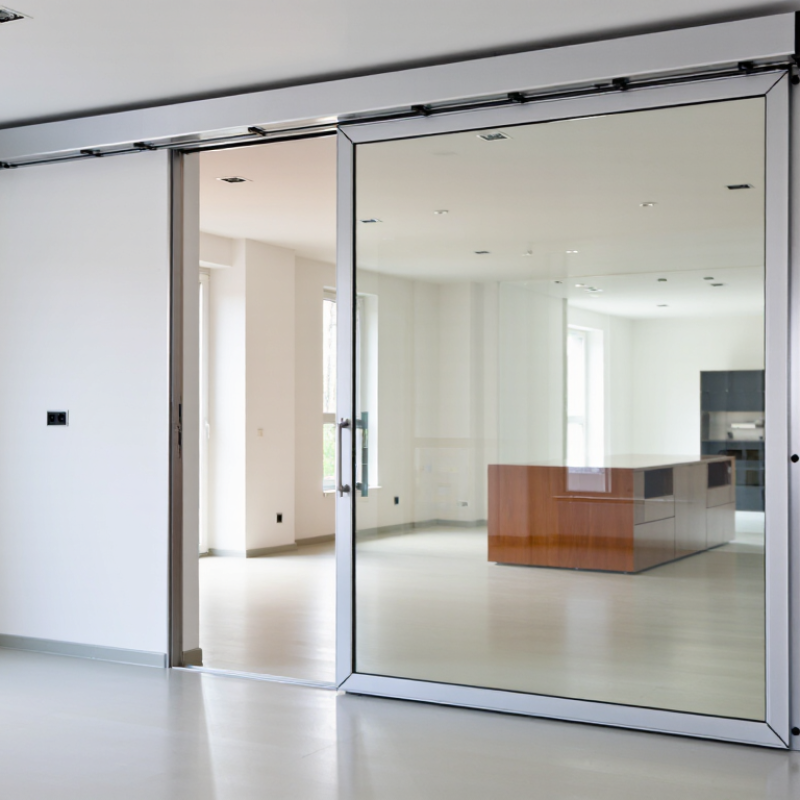
| Definition | What it is | An aluminum hanging door is a door system suspended from an overhead track or support structure. Its panels move by rolling or sliding along the upper track instead of relying primarily on floor-mounted hinges. |
| Main Components | Typical construction | Common components include an aluminum frame or panel, overhead track, rollers or hangers, guide hardware, handles, seals, fasteners, and optional locking or soft-closing devices. |
| Operating Principle | How it moves | The door’s weight is transferred to the overhead track through hangers or rollers. Floor guides may be used to control lateral movement and keep the panel aligned during operation. |
| Material Benefit | Lightweight structure | Aluminum generally has a lower density than steel, which can reduce the weight of the door panel and make manual operation easier when the track and hardware are correctly sized. |
| Corrosion Resistance | Performance in humid areas | Aluminum naturally forms a thin oxide layer that helps protect it from corrosion. Anodized or powder-coated surfaces can provide additional protection, but damage, salt exposure, and dissimilar-metal contact still require attention. |
| Space Efficiency | Clear floor area | Because the panel is suspended and usually slides parallel to the wall or opening, the system can avoid the floor swing area required by many hinged doors. The required side clearance depends on the opening and door configuration. |
| Installation | Structural support | The overhead structure must be strong, level, and properly anchored to support the door, track, and operating loads. Installation should follow the hardware manufacturer’s load ratings and fixing requirements. |
| Advantages | Ease of use | Smooth movement Low floor obstruction Lightweight panels Design flexibility
When properly installed, the system can provide convenient access, efficient use of space, and a clean architectural appearance. |
| Advantages | Design flexibility | Aluminum can be formed into framed, glazed, louvered, or solid-panel designs. Surface finishes and infill materials can be selected according to appearance, light transmission, privacy, and environmental requirements. |
| Limitations | Track dependency | The overhead track and rollers are critical to performance. Dirt, misalignment, insufficient support, or worn rollers may cause noise, increased operating force, uneven movement, or premature wear. |
| Limitations | Sound and thermal control | A lightweight sliding or hanging design may provide less sound insulation and thermal separation than a properly sealed, heavy, hinged door. Actual performance depends on the panel, seals, joints, glazing, and installation quality. |
| Limitations | Security and privacy | Security and privacy depend on the lock, panel construction, track design, overlap, seals, and surrounding frame. A basic hanging configuration should not automatically be treated as a high-security or fire-rated assembly. |
| Environmental Suitability | Where it may be used | Typical applications include interior room dividers, offices, retail areas, residential spaces, light commercial openings, and selected exterior locations where the system is specifically designed for weather exposure. |
| Routine Maintenance | Cleaning schedule | Clean the door panel, track, guides, and hardware regularly with a soft cloth, mild detergent, and clean water. Remove abrasive particles and dry the surfaces afterward, especially in dusty, coastal, or industrial environments. |
| Routine Maintenance | Inspection points | Check track alignment, roller movement, fasteners, end stops, guide components, handles, locks, seals, and finish condition. Look for looseness, unusual noise, binding, scratches, oxidation, or gaps around the panel. |
| Lubrication | Correct practice | Use only a lubricant approved for the specific roller and track assembly. Do not apply excessive oil to areas that can collect dust, and do not lubricate components that the hardware instructions identify as dry-running. |
| Safety | Operational checks | The door should move smoothly without excessive force, sudden stopping, or derailment risk. Replace damaged rollers, guides, stops, or fasteners promptly, and keep children or users from hanging on the door panel. |
| Service Life | What affects durability | Durability depends on aluminum alloy and finish, panel weight, track capacity, installation accuracy, frequency of use, cleaning practices, moisture and salt exposure, and the quality of replacement hardware. |
| Recommended Use | Best choice when | An aluminum hanging door is most suitable when low floor obstruction, relatively light operation, flexible appearance, and straightforward access are more important than maximum acoustic insulation, high impact resistance, or heavy-duty security. |


 Your message must be between 20-3,000 characters!