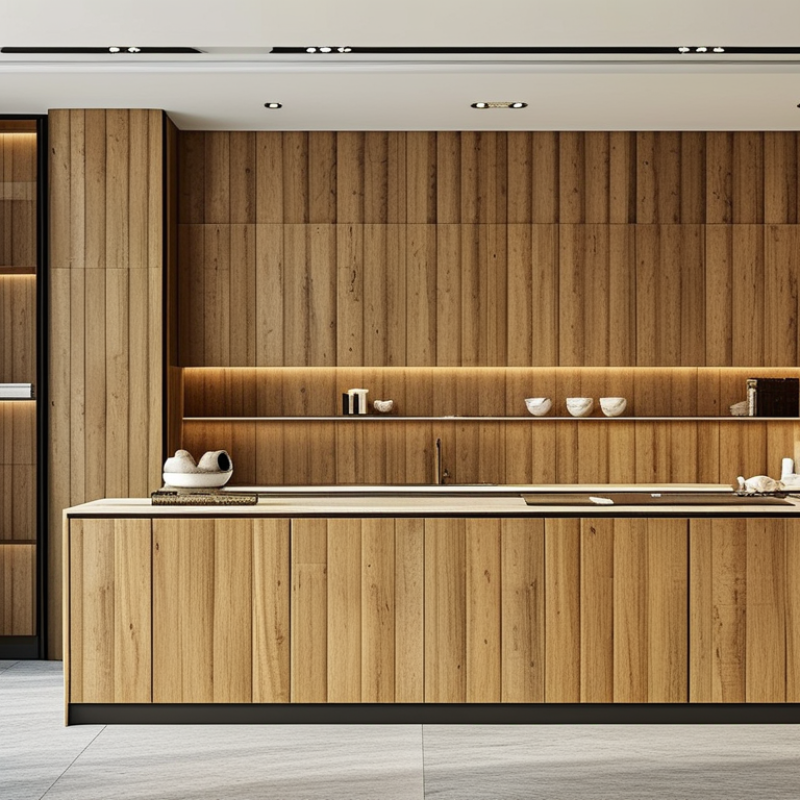
| Basic definition | A panel made by bonding thin wood veneer layers to a stable substrate or by laminating multiple veneer sheets into a structural panel. | Combines the visual character of real wood with a more consistent panel format. | The term can describe different constructions, so the core material and adhesive specification should be checked before purchase. |
| Furniture manufacturing | Used for cabinet doors, drawer fronts, tabletops, shelving, desks, and storage units. | Provides a real-wood appearance while helping create broad, uniform surfaces. | Edges may require matching veneer tape, solid-wood edging, or another suitable finishing method. |
| Interior wall and ceiling panels | Applied as decorative wall cladding, feature walls, ceiling panels, reception areas, and room dividers. | Adds natural texture, warmth, and visual continuity to interior spaces. | Allow for expansion gaps and follow the panel manufacturer’s installation and finishing instructions. |
| Architectural millwork | Used for built-in cabinets, wall systems, columns, counters, trim elements, and custom interior fittings. | Supports coordinated designs across large and small wood surfaces. | Veneer grain direction, panel matching, and color variation should be planned before fabrication. |
| Doors and partitions | Used as decorative faces for interior doors, sliding doors, screens, and non-load-bearing partitions. | Creates a durable, wood-look finish for high-visibility interior elements. | Door and partition cores must be selected for the required weight, stiffness, hardware, and fire-performance specifications. |
| Retail, hospitality, and office interiors | Used for counters, display fixtures, conference-room walls, office storage, restaurant interiors, and hotel furniture. | Offers a refined natural finish suitable for customer-facing environments. | High-traffic areas may need a protective finish with suitable resistance to abrasion, stains, and cleaning products. |
| Residential interiors | Commonly used for kitchens, living-room cabinetry, bedrooms, home offices, media units, and decorative storage. | Allows homeowners to use natural wood surfaces with controlled appearance and efficient fabrication. | Panels exposed to water or steam require a moisture-appropriate substrate, edge treatment, adhesive, and finish. |
| Structural applications | Structural laminated veneer products can be used in beams, headers, framing members, and engineered wood components when specifically rated for those purposes. | Engineered veneer construction can provide predictable strength and dimensional performance. | Decorative veneer-faced panels should not be treated as structural products unless they carry the required structural classification and documentation. |
| Typical thickness range | Decorative veneer-faced panels are commonly available in approximately 6–25 mm thicknesses, while structural products may be thicker or produced to project specifications. | Different thicknesses support applications ranging from lightweight cladding to furniture and cabinetry. | Actual availability varies by substrate, construction method, panel size, and local standards. |
| Surface finish | Panels may be supplied unfinished or coated with clear lacquer, oil, varnish, paint, or another specified finish. | Finishing can enhance color, grain visibility, stain resistance, and cleanability. | Finish samples should be reviewed because veneer color and grain naturally vary between sheets. |
| Dimensional stability | Cross-layer construction and a stable substrate generally reduce movement compared with a single solid-wood board, but wood-based panels still respond to humidity. | Helps reduce warping and supports larger, flatter interior surfaces. | Store panels flat in a dry, conditioned space and allow appropriate acclimatization before installation. |
| Moisture suitability | Standard interior panels are generally intended for dry or controlled indoor environments; moisture-resistant versions are available for specific conditions. | Selecting the correct grade improves service life in kitchens, utility areas, and other demanding spaces. | No wood veneer panel should be assumed suitable for exterior or continuously wet use without documented approval. |
| Environmental considerations | Veneer uses a thin layer of wood over a panel core, and many products are available with recycled-content cores or certified wood sources. | Can reduce the amount of solid timber needed for a broad visible surface. | Review wood-source documentation, formaldehyde-emission information, recyclability, and the adhesive system for the specific product. |


 Your message must be between 20-3,000 characters!