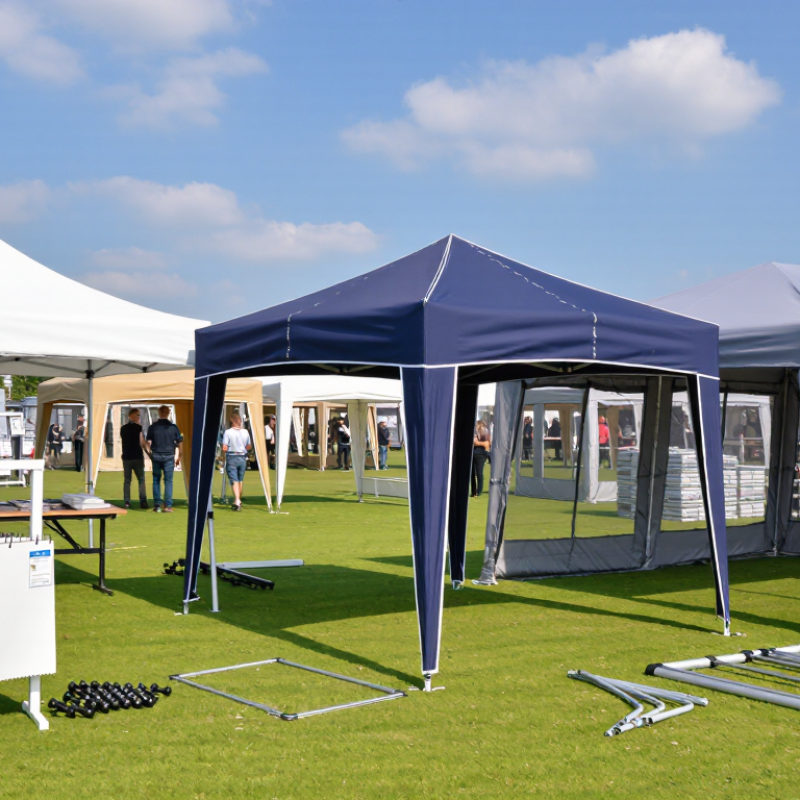
| Product Configuration | 10% | Confirm canopy type, footprint, peak height, sidewall configuration, frame material, roof design, color options, and packed dimensions before quotation. | Dimension drawings, technical datasheets, component list, product photographs, and approved sample. | Compare the quotation against the final specification sheet. Record dimensional tolerances and permitted substitutions in the purchase contract. | High |
| Structural Safety and Wind Performance | 15% | Require test-based wind performance information for the complete configuration, including frame, roof, sidewalls, anchors, and ballast. Do not rely only on a claimed wind-speed figure. | Independent test report, engineering calculation, installation manual, anchoring plan, and defined test conditions. | Check whether the test configuration matches the purchased size and whether the stated wind value applies to the complete installed structure. | High |
| Frame Material and Corrosion Resistance | 10% | Verify frame alloy or steel grade, tube dimensions, wall thickness, joint design, surface treatment, and corrosion-protection method. | Material declaration, tube specifications, coating information, salt-spray or corrosion-test report where applicable, and factory inspection records. | Use third-party inspection or random sampling to check tube dimensions, weld quality, coating uniformity, and joint fit. | High |
| Fabric Performance | 12% | Specify fabric composition, mass per unit area, tear strength, tensile strength, seam strength, UV resistance, colorfastness, and water resistance according to the intended use. | Fabric test reports, batch traceability, material composition declaration, seam-construction details, and production sample. | Test samples from the actual production batch. Compare the results with the agreed specification rather than a general catalog value. | High |
| Flame-Resistance Compliance | 12% | Identify the destination-market requirements before production. Temporary structures may require fire-performance documentation under local building, event, or fire-safety rules. | Current laboratory report, material identification, test method, report scope, and declaration of conformity where required. | Confirm that the report covers the exact fabric, coating, color, and construction supplied. Check validity and laboratory accreditation. | High |
| Chemical and Product-Safety Documentation | 8% | Screen for applicable requirements concerning restricted substances, heavy metals, plasticizers, formaldehyde, packaging materials, and product labeling. | Material safety information, restricted-substance test report, supplier declarations, packaging specification, and country-specific compliance documents. | Use a destination-country compliance checklist and request testing from an independent laboratory for higher-risk materials or markets. | High |
| Quality Management System | 8% | Prefer a documented quality system with incoming-material inspection, in-process controls, final inspection, nonconformance handling, and corrective-action records. | Quality manual, inspection plan, calibration records, internal audit summary, corrective-action examples, and certification if available. | Audit the production site or appoint an inspection agency. Verify that documented procedures are used on the actual production line. | High |
| Production Capacity and Scalability | 7% | Assess monthly capacity, sewing-line capability, frame-processing capacity, subcontracting exposure, workforce stability, and peak-season production plans. | Capacity statement, production schedule, equipment list, staffing plan, and previous production records with confidential details removed. | Compare available capacity with the required order quantity and delivery window. Include a contingency plan for urgent replenishment. | Medium |
| Sample Approval and Change Control | 6% | Require a signed golden sample or approved digital specification. Any change to fabric, frame, accessories, packaging, or subcontractor should require written approval. | Approved sample, bill of materials, inspection checklist, change-control procedure, and pre-production sample record. | Retain a reference sample and compare pre-shipment goods against it using measurable acceptance criteria. | High |
| Packaging and Export Readiness | 5% | Packaging should protect fabric and coated surfaces from moisture, abrasion, compression, and contamination during international transport. | Packing list, carton dimensions, gross and net weights, pallet plan, packaging photographs, shipping marks, and moisture-protection method. | Calculate container utilization and landed logistics cost. Conduct a packaging-drop or vibration review for fragile components where appropriate. | Medium |
| Incoterms and Landed-Cost Transparency | 4% | Request comparable quotations under a clearly stated Incoterms® 2020 rule, currency, port or place, payment terms, tooling charges, spare parts, and export documents. | Formal quotation, cost breakdown, commercial invoice format, packing list sample, and stated assumptions. | Compare total landed cost rather than unit price alone, including freight, duty, inspection, insurance, inland delivery, and compliance expenses. | Medium |
| Lead Time and Delivery Reliability | 5% | Separate sample lead time, material-procurement time, production time, inspection time, and transit time. Use a written shipment date and escalation process. | Production schedule, capacity reservation, historical on-time-delivery data, order milestones, and delay-response procedure. | Measure on-time delivery against the confirmed ship date over multiple orders. Do not treat quoted lead time as historical performance. | High |
| Warranty, Spare Parts, and After-Sales Support | 4% | Define warranty duration, exclusions, claim evidence, response time, replacement-part availability, and responsibility for transport or labor costs. | Written warranty policy, spare-parts list, claim form, service-response commitment, and replacement procedure. | Evaluate the support process using a practical warranty scenario and confirm whether replacement components remain available for the expected product life. | Medium |
| Supplier Verification and Ethical Risk | 4% | Verify legal registration, manufacturing location, ownership of production assets, labor practices, environmental controls, and subcontracting arrangements. | Business registration, factory address, audit consent, environmental permits where applicable, labor-policy documents, and subcontractor disclosure. | Use independent factory audits, document verification, site photographs with timestamps, and reference checks before placing a large order. | High |


 Your message must be between 20-3,000 characters!