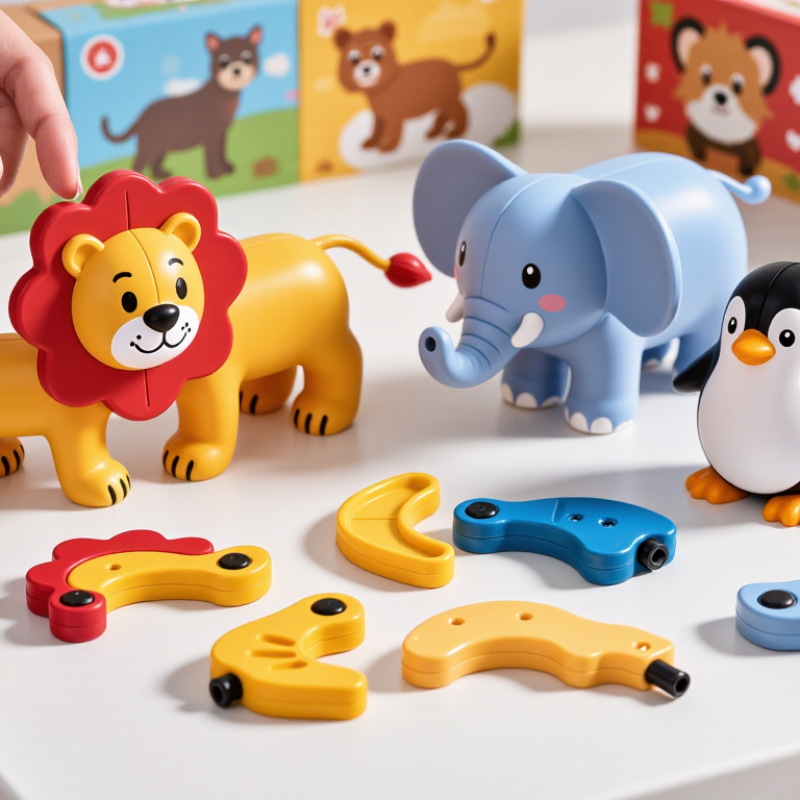
What Are the Top Magnet Animal Toys for Global Buyers?
Magnet Animal Toys are gaining attention among global buyers who want tactile play, compact storage, and memorable product design. Grand View Research estimates that the global toys market reached approximately USD 108 billion in 2023. Its report also projects continued growth through 2030, supported by educational and interactive products. Circana’s Global Toy Industry Performance report shows that toy demand varies sharply by country, age group, price tier, and retail channel. Therefore, one winning design rarely fits every market.
Buyers should examine magnetic strength, animal-part attachment, surface durability, and age grading. Small detachable magnets require careful risk assessment and reliable testing. Joan Lawrence, a toy-safety authority at The Toy Association, states, “Toy safety is a shared responsibility.” That principle matters here. Importers, manufacturers, laboratories, retailers, and parents all influence product safety.
Details reveal quality. A lion’s tail should attach smoothly, without sharp edges or loose coatings. Packaging should explain age suitability, care instructions, and responsible use clearly. Products should also meet applicable requirements, such as ASTM F963 in the United States or EN 71 in European markets. Certification alone does not replace practical inspection.
The category remains imperfectly measured.
Public reports rarely isolate Magnet Animal Toys as a separate segment. This creates uncertainty around exact global sales figures. Still, buyer behavior is visible through educational demand, gift purchasing, and online product reviews. The strongest products combine recognizable animals, satisfying magnetic movement, safe construction, and manageable pricing. Global buyers should compare laboratory evidence with real handling experience. Attractive packaging helps, but it cannot repair weak design.
Magnet animal toys are play figures shaped like fish, insects, farm animals, or dinosaurs. Small permanent magnets sit inside the head, body, feet, or connecting joints. When opposite poles face each other, they attract and snap together. Matching poles repel. This simple force lets children build a crocodile chain, join a butterfly’s wings, or rearrange a loose animal puzzle. The mechanism needs no batteries. It relies on magnetic fields, material strength, and careful placement.
For global buyers, magnet type matters. Ferrite magnets usually provide moderate attraction and lower cost. Neodymium magnets are much stronger, even in tiny sizes. That strength can improve assembly, but it increases safety demands. The U.S. Consumer Product Safety Commission’s 2023 Toy-Related Deaths and Injuries report estimated 231,700 toy-related emergency-department injuries among children under 15. Its safety guidance highlights hazards from small parts and accessible magnets. Buyers should check age grading, sealed magnet compartments, pull-force testing, and clear warning labels. ASTM F963-23 also sets requirements for toys sold in the United States.
Market interest is expanding with educational play. Grand View Research valued the global educational toys market at approximately US$61.6 billion in 2023 and forecast continued growth through 2030. That figure covers more than magnetic animals, but it shows strong demand for hands-on learning. I would not judge quality by magnetic strength alone. A weaker magnet may be safer and more suitable. Packaging can look convincing. The internal construction still deserves inspection.
Which Animal-Themed Magnet Toys Are Most Popular Worldwide?
Worldwide, animal-themed magnetic toys are gaining attention because they combine familiar creatures with hands-on problem solving. Circana’s 2023 Global Toy Industry Report recorded a 7% decline across major toy markets, making repeat-play value increasingly important.
Magnetic animal building tiles answer that need. Children can create turtles, lions, or unusual mixed creatures, then rebuild them minutes later. Magnetic fishing games remain popular too. They offer clear goals, bright pieces, and simple parent-child interaction.
Research and Markets’ 2024 educational-toy analysis identifies STEM learning, tactile play, and screen-free activities as strong growth drivers.
Animal magnet puzzles fit these trends, especially when they teach habitats, body parts, or matching skills. Grand View Research also links educational toy demand with early cognitive development and interactive learning. For global buyers, the strongest products usually have large, easy-grip pieces and quiet magnetic connections. Not every colorful set performs equally well. Weak illustrations, loose parts, or repetitive play can quickly reduce value.
Safety needs expert attention. Magnets should remain securely enclosed, with clear age grading and testing aligned with relevant requirements such as EN 71, ASTM F963, and ISO 8124.
Buyers should request test documentation, batch traceability, and packaging translations for each target market. A practical concern is often missed: animal names and images may not translate equally across cultures. A panda, camel, or frog can carry different learning meanings. Regional testing is still necessary.
How Should Buyers Compare Safety, Materials, and Durability?
For global buyers, magnet animal toys should be compared as safety products, not only cute accessories. The U.S. CPSC’s Toy-Related Deaths and Injuries report estimated about 203,000 toy-related emergency visits in 2023 among children under 15. CPSC magnet safety data also recorded more than 2,400 magnet-ingestion injuries from 2017 to 2021. These figures are not a product scorecard. They show why enclosed magnets need serious scrutiny.
Ask for testing against applicable standards, including ASTM F963 in the United States and ISO 8124 for international supply chains. Check magnet retention after drop, pull, twist, bite, and seam tests. A stitched fabric shell can hide weak bonding. ABS plastic may resist moisture, but impact can create sharp edges. For soft toys, inspect seam density, filling security, and coating flaking. Confirm the magnet’s grade, size, polarity, and flux documentation. “Strong magnet” is not enough.
Tips: Request laboratory reports for the exact model and production batch. Test samples after heat, humidity, and repeated washing. Use a calibrated pull gauge when possible. Keep warnings readable in the buyer’s market language. I would reject any sample with a loose magnet or cracked casing. No checklist is perfect. Factory documents can also become outdated, so independent pre-shipment checks remain worthwhile.
Top Magnet Animal Toys: Buyer Comparison
Comparative buyer checklist scores from 1 to 5, based on key purchasing considerations: safety design, material transparency, and expected durability. Higher scores indicate stronger performance. Buyers should still verify age grading, magnet warnings, testing documentation, and product samples before purchase.
Evaluation scale: 1 = weak documentation or performance; 5 = strong documentation or performance. The scores are a comparative purchasing benchmark, not a laboratory certification.
What Age Groups and Learning Needs Do These Toys Support?
What Are the Top Magnet Animal Toys for Global Buyers?
For toddlers aged three to five, large magnetic animal pieces support color recognition, matching, and simple vocabulary. Children can connect a lion’s body, count spots, or sort animals by habitat. These actions strengthen hand control and early problem-solving.
Adult supervision remains important, especially when pieces can fit inside a child’s mouth. Buyers should check the stated age range, magnet enclosure, material safety, and testing documents for each market.
Children aged five to eight often need more challenge than basic matching. Animal sets with interchangeable parts encourage sequencing, pattern building, and imaginative storytelling. A child might create a farm scene, then explain why each animal belongs there. This supports language development and social play.
However, some sets promise advanced learning but offer only repetitive assembly. That difference deserves careful review.
For children aged eight and above, magnetic animal models can introduce balance, structure, and simple engineering ideas. Buyers may prefer sets with habitat cards, classification tasks, or open-ended building options. These features support independent learning and classroom activities.
No age chart is perfect. A younger child with strong spatial skills may enjoy complex designs, while an older child may need clearer instructions. Global buyers should consider language accessibility, durable construction, and replacement-part availability before choosing a top-selling format.
How Can Global Buyers Evaluate Suppliers, Standards, and Costs?
When evaluating magnet animal toys, global buyers should inspect the supplier before comparing prices. Request factory photographs, production records, material declarations, and recent safety test reports. Ask who performed each test and whether the report matches the exact toy model. A sample should feel solid, with secure magnet housing and smooth, sealed surfaces. Tiny loose parts are a serious warning.
Standards vary by destination, so suppliers must understand the buyer’s target markets. Check age grading, warning labels, packaging language, and requirements for magnetic components. Ask for evidence covering mechanical strength, paint migration, chemical content, and magnet retention. Independent laboratory testing adds confidence, but it does not replace buyer inspection. I have found that vague answers often reveal weak process control.
Cost comparisons need more than a unit price. Include tooling, sample revisions, testing, packaging, freight, customs handling, and possible inspection fees. A low quote may exclude essential documentation. Calculate the landed cost per sellable unit. Also review minimum order quantities and replacement policies. Small trial orders reduce risk, although they can raise the unit cost. That trade-off deserves attention. I would not rely on attractive samples alone; production consistency can change after approval. Keep signed specifications, approved samples, batch records, and corrective-action agreements. Clear records make supplier discussions more practical when defects appear.