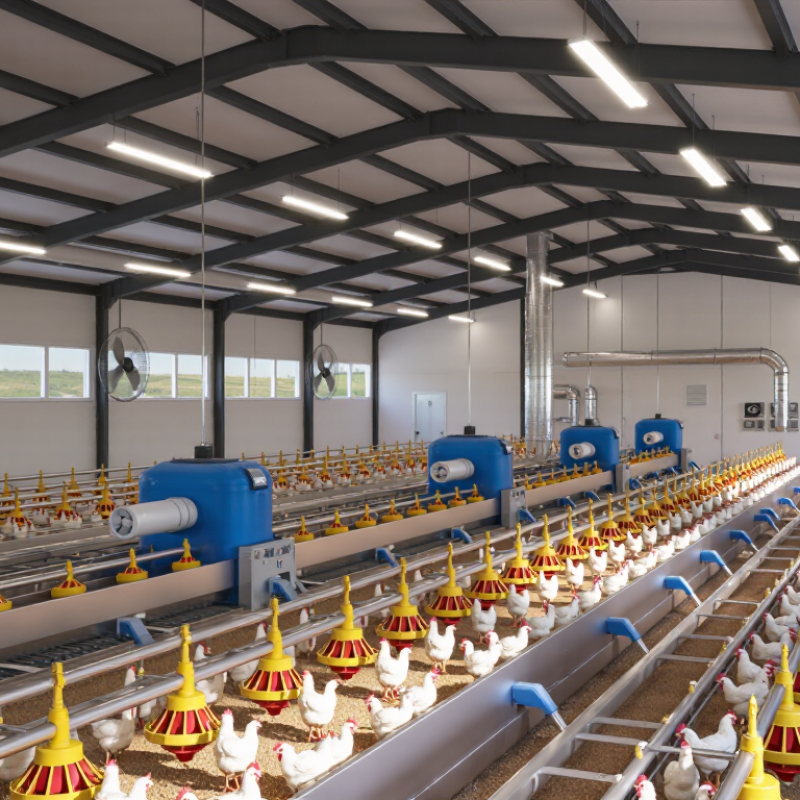
| Feed Delivery | Broiler feed conversion ratio (FCR) | 1.60–1.80 kg feed per kg live weight under well-managed commercial conditions | Lower FCR reduces feed cost and nutrient waste; results vary with genetics, climate, health, feed quality, and slaughter age | Request FCR reporting method, target live weight, mortality adjustment, and flock age at measurement |
| Pan Feeding | Birds per feed pan | Approximately 45–60 broilers per pan, depending on pan design and bird size | Adequate access supports uniform growth and helps reduce competition and uneven body weight | Confirm pan diameter, usable feeding circumference, adjustment range, and clean-out capability |
| Feed Lines | Feed distribution uniformity | Aim for approximately 90% or higher uniformity across feed pans after line adjustment | More consistent feed availability improves flock uniformity and limits selective feeding | Evaluate auger capacity, anti-bridging design, line length limits, and calibration procedure |
| Drinking System | Nipple drinker capacity | Usually about 10–15 birds per nipple, subject to local welfare rules, nipple type, and house conditions | Sufficient access supports hydration, feed intake, growth, and litter quality | Check pressure regulators, height adjustment, flow testing, water filtration, and leak alarms |
| Water Management | Water-to-feed consumption ratio | Approximately 1.6–2.0 litres of water per kg of feed in moderate conditions; heat can increase demand | Unexpected changes can indicate heat stress, leakage, disease, or feed and water-system problems | Require water meters, remote alerts, flush points, and easily sanitized contact surfaces |
| Tunnel Ventilation | Air speed at bird level | Approximately 2.0–3.0 m/s during hot-weather tunnel ventilation, adjusted for bird age and temperature | Improves wind-chill cooling and helps control heat stress when correctly designed and maintained | Verify fan capacity, static-pressure performance, inlet design, emergency ventilation, and backup power |
| House Climate Control | Relative humidity | Generally maintain about 50–70% relative humidity after the brooding period where practical | Balanced humidity supports respiratory comfort and litter quality; excessive humidity increases wet-litter risk | Check sensor accuracy, sensor placement, controller calibration, and alarm history |
| Brooding Equipment | Brooding temperature at chick level | Approximately 32–35°C during placement, then gradually reduced according to chick behavior and house conditions | Correct early temperature supports feed and water intake, leg health, and early growth | Assess heating uniformity, fuel safety, ignition reliability, zoning, and low-temperature alarms |
| Lighting | Light intensity and dark period | Use a controlled lighting program with a daily dark period; intensity is commonly reduced after brooding while maintaining bird access to feed and water | Supports rest, activity balance, welfare, and consistent feeding behavior | Confirm dimming range, light uniformity, flicker performance, timer accuracy, and emergency lighting |
| Litter and Floor Management | Litter moisture | Target dry, friable litter; approximately 20–25% moisture is often used as a practical management range | Dry litter helps reduce footpad damage, ammonia generation, and pathogen pressure | Review drinker leak prevention, ventilation control, floor drainage, and litter-depth compatibility |
| Automation and Monitoring | Critical alarm response | Continuous monitoring of temperature, humidity, ventilation status, water use, feed use, and power supply | Early alerts can reduce losses caused by equipment failure, heat stress, or water interruption | Confirm local connectivity, offline operation, data export, alarm escalation, and manual override functions |
| Energy and Backup | Power continuity | Provide automatic backup generation and tested emergency ventilation for climate-controlled houses | Maintains life-support systems during grid outages, particularly in hot or cold weather | Request load calculations, automatic transfer-switch details, fuel autonomy, preventive-maintenance plan, and test records |


 Your message must be between 20-3,000 characters!