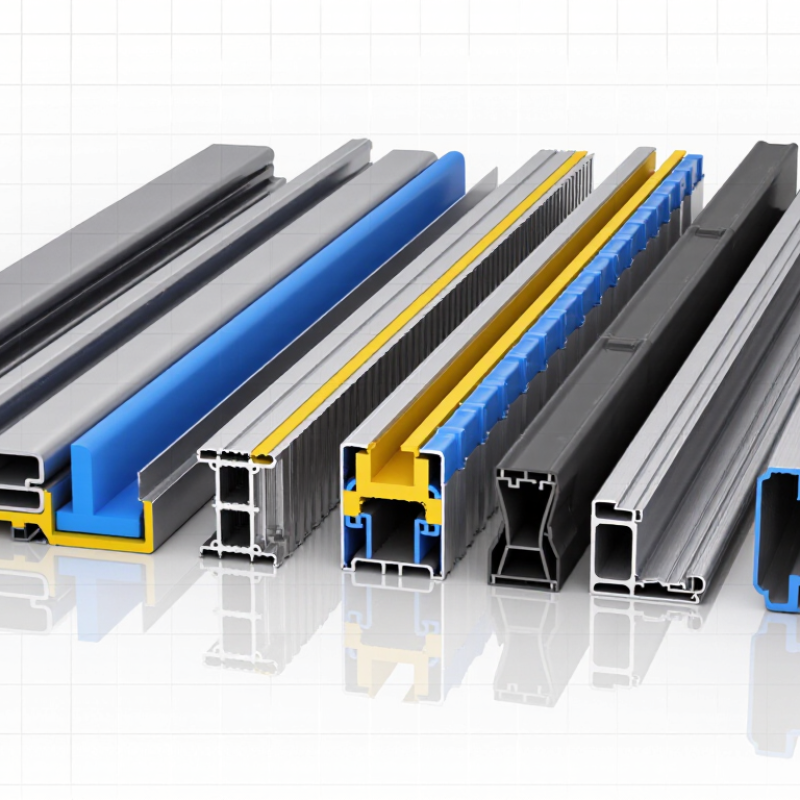
| 1 | Glass-Fiber-Reinforced Polyamide Strip | Polyamide 6.6 reinforced with approximately 25% glass fiber | Approximately 0.30–0.35 W/m·K | 14.8–40 mm | Thermally broken aluminum windows, doors, curtain walls, and façades | High dimensional stability, strong mechanical performance, good moisture resistance, and compatibility with industrial aluminum rolling or crimping systems | EN 14024; EN ISO 10077-2; ISO 4892-2 for accelerated weathering where required | Check glass-fiber content, tensile and shear strength, strip geometry, dimensional tolerance, and compatibility with the aluminum alloy and coating process |
| 2 | Polyamide Insulating Box Profile | Extruded reinforced polyamide, often produced as a hollow or multi-chamber section | Approximately 0.30–0.35 W/m·K | 20–50 mm | Large aluminum frame sections, sliding doors, high-performance windows, and façade mullions | Greater insulation depth than a simple strip, improved stiffness-to-weight ratio, and the ability to create multiple insulating chambers | EN 14024; EN ISO 10077-2; EN 12152 and EN 12154 for relevant curtain-wall air and water performance | Evaluate chamber design, drainage, insertion method, corner-joint strength, and the effect of the profile on the complete-frame U-value |
| 3 | Pour-and-Debridge Polyurethane Thermal Break | Rigid polyurethane foam cast between aluminum sections and mechanically debridged after curing | Approximately 0.025–0.035 W/m·K | 20–45 mm | Aluminum windows, doors, façades, and thermally improved framing systems | Very low material conductivity, flexible cavity design, and efficient insulation for complex aluminum cross-sections | EN ISO 10077-2; ISO 8302 or ASTM C177 for steady-state thermal resistance; ASTM C518 for heat-flow measurements | Confirm foam density, adhesion, curing consistency, debridging quality, dimensional stability, and long-term resistance to moisture and temperature cycling |
| 4 | Rigid PVC Thermal Separator | Unplasticized polyvinyl chloride, commonly used as an insulating separator or glazing component | Approximately 0.16–0.20 W/m·K | 2–30 mm | Window glazing pockets, door thresholds, light-duty aluminum frames, and secondary thermal isolation | Low cost, easy extrusion, good electrical insulation, and resistance to many common chemicals | EN ISO 10077-2; ISO 4892-2 for weathering evaluation; applicable regional PVC fire and building regulations | Review impact strength, low-temperature behavior, UV stabilization, fire classification, shrinkage, and whether the material is suitable for structural load transfer |
| 5 | Polyurethane Foam Insulating Insert | Closed-cell or semi-closed-cell polyurethane foam, supplied as a flexible insert or rigid preformed section | Approximately 0.025–0.040 W/m·K | 10–60 mm | Thermal enhancement of aluminum profiles, façade cavities, door panels, and retrofit frame systems | Excellent insulation efficiency per unit thickness, lightweight construction, and easy adaptation to irregular cavities | ISO 8302; ASTM C518; EN ISO 10077-2 for integration into a complete window or façade assembly | Check water absorption, compression recovery, adhesive compatibility, dimensional stability, smoke and fire behavior, and resistance to installation damage |
| 6 | Expanded or Extruded Polystyrene Insert | Expanded polystyrene or extruded polystyrene foam | Approximately 0.029–0.040 W/m·K | 15–80 mm | Insulated façade panels, spandrel zones, door cores, and non-load-bearing thermal infill areas | Low thermal conductivity, low density, easy cutting, and economical use in large insulated cavities | EN 13163 for expanded polystyrene; EN 13164 for extruded polystyrene; ISO 8302 or ASTM C518 for thermal testing | Assess water absorption, compressive strength, fire classification, vapor behavior, dimensional tolerances, and suitability for the intended cavity geometry |
| 7 | Aerogel Thermal Break Strip or Blanket | Silica-aerogel composite reinforced with fibers or flexible carrier materials | Approximately 0.013–0.020 W/m·K | 5–20 mm | High-performance retrofit applications, narrow frame cavities, steel connections, and space-constrained thermal bridges | Very low thermal conductivity, thin construction, and strong performance where installation space is limited | ISO 8302; ASTM C177; ASTM C518; EN ISO 10211 for thermal-bridge assessment in building details | Consider material cost, dust control, compression behavior, edge sealing, handling requirements, moisture exposure, and compatibility with adhesives or sealants |
| 8 | Glass-Fiber-Reinforced Thermoplastic Profile | Glass-fiber-reinforced thermoplastic such as reinforced polycarbonate, polyester, or other engineering polymers | Approximately 0.25–0.40 W/m·K | 10–50 mm | Structural thermal isolators, façade brackets, window reinforcement zones, and custom engineered frame components | Good strength-to-weight ratio, corrosion resistance, electrical insulation, and freedom for complex custom geometries | EN ISO 10077-2; ISO 527 for tensile properties; ISO 178 for flexural properties; ISO 75 for heat-deflection behavior | Verify fiber orientation, creep resistance, coefficient of thermal expansion, water absorption, fire performance, and load capacity over the service temperature range |
| 9 | EPDM Thermal Isolation Gasket | Ethylene-propylene-diene rubber, normally used as a flexible gasket or isolating seal | Approximately 0.20–0.25 W/m·K | 1–15 mm | Glazing systems, pressure plates, aluminum-to-glass interfaces, and flexible air or water seals | Excellent weathering, ozone, and UV resistance; flexible sealing; and reliable accommodation of movement | EN 12365 for building hardware gaskets; EN ISO 10077-2 for thermal calculations; ISO 815 for compression set evaluation | Confirm hardness, compression set, tensile strength, compatibility with sealants and coatings, weather resistance, and the required air and water tightness class |
| 10 | Thermal Break Pad or Structural Shim | High-density polymer, reinforced composite, glass-fiber laminate, or other load-bearing insulating material | Approximately 0.20–0.50 W/m·K | 3–30 mm | Base plates, curtain-wall brackets, balcony connections, steel-to-concrete interfaces, and point thermal bridges | Reduces conductive heat flow through fasteners and supports while maintaining controlled load transfer | EN ISO 10211; ISO 8302; ASTM C177; EN 1993 and EN 1992 where the shim forms part of a structural connection | Prioritize compressive strength, creep, fire behavior, bearing area, fastener interaction, moisture resistance, and verified structural calculations for the connection |


 Your message must be between 20-3,000 characters!