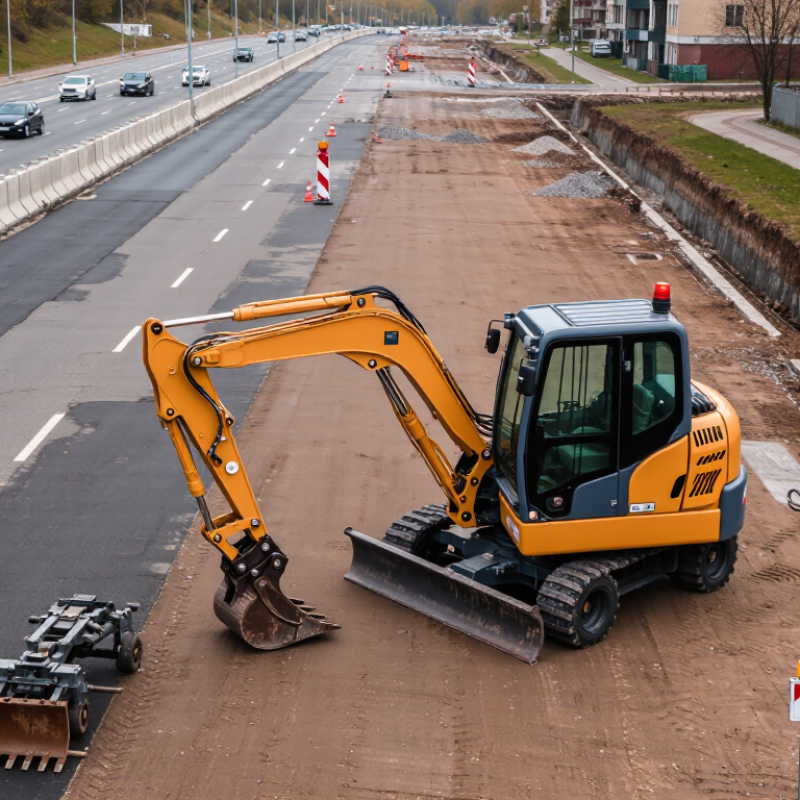
| 1 | Operating Weight | Select an operating-weight class that matches the work: approximately 1.5–6 tonnes for compact urban work, 6–15 tonnes for general road construction, and above 15 tonnes for heavy excavation. | Compare the excavator weight with bridge limits, access-road capacity, transport regulations, and the required digging force. | A heavier machine generally provides greater stability and digging performance, but it can increase ground pressure, transport cost, and infrastructure risk. |
| 2 | Travel Speed and Mobility | For roadable wheeled excavators, a typical maximum travel speed is about 20–35 km/h. Crawler excavators are usually transported rather than driven long distances on public roads. | Confirm travel speed, tire or track configuration, steering mode, braking performance, and the distance between work zones. | Higher travel speed can reduce relocation time, while suitable steering and braking systems improve control during frequent movement between sites. |
| 3 | Road-Legal Configuration | The machine should comply with applicable local requirements for width, height, axle load, lighting, mirrors, warning devices, braking, and road registration. | Verify the transport width and height with attachments installed, and check whether special permits or escort vehicles are required. | A machine that cannot legally or safely travel on public roads may require additional low-loader transport, increasing downtime and operating cost. |
| 4 | Overall Dimensions | Measure overall length, width, height, tail swing, front swing, and ground clearance. Compact configurations are often preferable on narrow urban roads and confined sites. | Measure the narrowest gate, lane, bridge, underpass, and turning point along the complete access route. | A machine may fit the work area but still fail at an entrance, bend, overhead obstruction, or restricted road section. |
| 5 | Turning Radius and Steering | Prioritize a short turning radius, multiple steering modes, and a suitable articulation or axle design when working on narrow roads or around traffic. | Assess the minimum turning circle, steering response, counterweight clearance, and ability to reposition without crossing active traffic lanes. | Better maneuverability reduces reversing, lane occupation, property damage, and the need for repeated repositioning. |
| 6 | Ground Pressure and Surface Protection | Use tires, tracks, mats, or wider undercarriage options according to the surface. Soft ground, newly paved roads, and finished shoulders require lower-impact solutions. | Review tire or track width, axle load, ground pressure, turning behavior, and the risk of rutting or pavement damage. | Lower surface pressure and controlled steering help protect asphalt, sidewalks, drainage edges, landscaped areas, and unfinished shoulders. |
| 7 | Visibility and Traffic Safety | Choose a cab with clear sightlines, effective mirrors or camera systems, work lights, road lights, audible warnings, and visible beacon equipment where required. | Inspect blind spots around the rear, attachment, wheels, and counterweight; confirm the operator can see pedestrians and traffic-control personnel. | Improved visibility lowers the risk of collisions, struck-by incidents, and damage to barriers, vehicles, utilities, and roadside assets. |
| 8 | Stability and Outrigger Performance | For wheeled excavators, verify the stabilizer layout, leveling capability, lifting chart, and allowable operation on slopes. Use the manufacturer’s rated load chart for each configuration. | Check the required stabilizer footprint, uneven-ground performance, slope limits, and lifting capacity with the selected boom, dipper, and attachment. | Stable support is essential for safe digging, lifting, and loading beside traffic lanes, trenches, embankments, and confined work areas. |
| 9 | Attachment Compatibility | Match the hydraulic flow, pressure, coupler capacity, attachment weight, bucket width, and breakout force to the planned tasks. | Confirm compatibility with buckets, breakers, compactors, grapples, tiltrotators, lifting hooks, and any required quick-coupling system. | Correct attachment matching improves productivity and prevents excessive hydraulic load, unstable handling, premature wear, and unsafe lifting. |
| 10 | Transport, Fuel, and Site Support | Compare fuel or energy capacity, daily operating range, service access, transport method, lifting points, and availability of routine maintenance support. | Estimate working hours per shift, refueling or charging access, relocation frequency, service intervals, and emergency-repair response requirements. | Reliable support planning reduces idle time and ensures the excavator can complete roadwork without avoidable transport, fueling, or maintenance delays. |


 Your message must be between 20-3,000 characters!