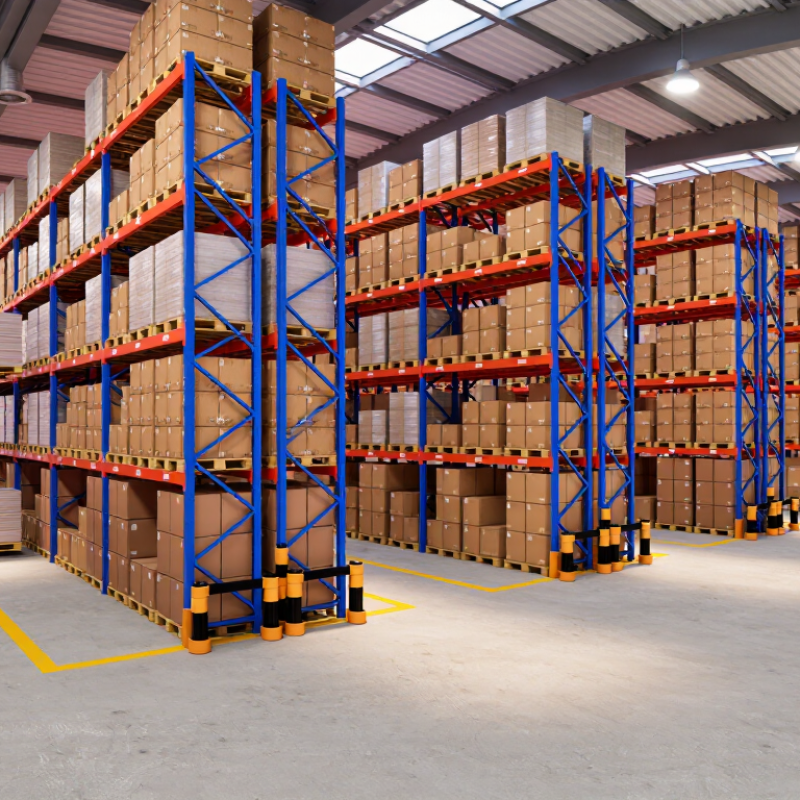
| Selective Pallet Racking | Low to medium
Usually about 30–50% of floor area used for storage, depending on aisle width and layout. | 100%
Every pallet position is directly accessible. | Well suited to FIFO or FEFO when inventory is managed by location and date. | Works with counterbalance forklifts, reach trucks, and narrow-aisle trucks. Standard aisle requirements commonly range from approximately 2.4–3.7 m, depending on the truck and load. | Protect uprights and frames, anchor the structure to the floor, maintain rated load signs, inspect beams and connectors, and prevent pallet overhang. | Best general-purpose option for many SKUs, mixed pallet quantities, frequent picking, and operations requiring maximum access. |
| Double-Deep Pallet Racking | Medium
Provides more storage positions than single-deep selective racking while retaining multiple lanes. | About 50%
Two pallets are stored in depth; the rear pallet is not directly accessible from the aisle. | Suitable for LIFO. FIFO is possible only with careful lane and inventory control. | Requires reach trucks with double-deep capability. Greater fork reach and accurate load placement are necessary. | Use approved equipment, confirm maximum reach and load capacity, protect against load displacement, and maintain clear visibility during deep placement. | Suitable for facilities with medium-to-high pallet quantities per SKU and less frequent access to reserve inventory. |
| Drive-In / Drive-Through Racking | High
Reduces the number of aisles and can achieve high pallet density in block storage. | Low
Access is lane-based; pallets inside a lane are not individually accessible. | Drive-in systems generally favor LIFO. Drive-through layouts can support FIFO when loading and unloading occur from opposite sides. | Requires forklift entry into storage lanes. Best for uniform pallets and relatively few SKUs with multiple pallets per SKU. | Install guide rails and impact protection, control forklift speed, keep rails and supports in good condition, and ensure pallets are compatible with the system. | Best for high-volume, low-SKU operations, seasonal products, cold storage, and products that can tolerate limited direct access. |
| Pallet Flow Racking | High
Uses inclined roller lanes to reduce aisle requirements and organize pallet movement. | Lane-based
Individual pallet access depends on lane assignment and product rotation. | FIFO
Loading and picking occur from opposite sides of the lane. | Forklifts load from the replenishment side while operators pick from the discharge side. Brakes, rollers, and lane separators control pallet movement. | Verify pallet quality and dimensions, inspect rollers and speed controllers, use pallet stops, and maintain clear loading and discharge zones. | Well suited to perishable goods, date-sensitive inventory, high-throughput distribution, and operations requiring controlled FIFO rotation. |
| Push-Back Racking | High
Stores multiple pallets deep while preserving more aisle access than drive-in systems. | Lane-based
Multiple pallets share a lane, so direct access to every pallet is limited. | LIFO
Last pallet loaded is normally the first pallet retrieved. | Forklifts load and retrieve pallets from the same aisle. Cart or roller systems move pallets toward the aisle as positions are emptied. | Control load placement speed, inspect carts and rails, use compatible pallets, and prevent operators from entering storage lanes. | Good for medium-turnover products, multiple pallets per SKU, and facilities seeking greater density without fully sacrificing aisle access. |
| Cantilever Racking | Medium to high for long loads
Provides open vertical and horizontal storage without front columns. | High
Each arm position is generally accessible from the aisle. | Depends on the product and handling method; FIFO is possible with disciplined location control. | Suitable for forklifts, side loaders, and manual handling of long products. Aisle width must accommodate the selected truck and load length. | Balance loads across arms, use end stops where required, protect columns, respect arm capacity, and secure unstable or cylindrical materials. | Designed for lumber, pipe, steel sections, furniture, carpet, panels, and other long or irregularly shaped products. |
| Carton Flow Racking | Medium to high for small-item picking
Uses inclined roller or wheel beds to present cartons at the pick face. | High
Each SKU can have a dedicated forward-pick lane. | FIFO
Replenishment occurs from the rear and picking from the front. | Primarily designed for manual order picking. Replenishment may use carts, pallet jacks, or forklifts depending on rack height. | Keep pick faces organized, prevent cartons from exceeding lane capacity, inspect rollers and dividers, and provide ergonomic working heights. | Best for piece picking, e-commerce fulfillment, spare parts, and high-SKU operations with frequent manual order assembly. |
| Mobile Pallet Racking | Very high
Moves rack rows to open only the aisle required for an operation, reducing fixed aisle space. | High
Access is available to the selected open aisle, although simultaneous access is limited. | Can support FIFO or LIFO, depending on layout and inventory procedures. | Uses powered mobile bases with integrated controls and safety sensors. Access is sequential rather than continuously open across all aisles. | Requires floor assessment, emergency-stop systems, obstacle detection, interlocks, regular maintenance, and strict operating procedures. | Useful where floor space is expensive, storage density is critical, and inventory access is periodic rather than simultaneous. |
| Automated Storage and Retrieval System (AS/RS) | Very high
Uses vertical volume and automated equipment to reduce travel aisles and improve storage control. | System-controlled
Access depends on software, equipment capacity, and configured storage locations. | Supports FIFO, LIFO, FEFO, and batch rules when correctly configured in the warehouse-control system. | Uses cranes, shuttles, conveyors, or robotic vehicles. Requires reliable interfaces between storage equipment, warehouse software, and material-flow systems. | Requires guarding, access control, emergency stops, maintenance procedures, safe human-machine interfaces, and validated software controls. | Best for high-throughput, high-volume operations requiring traceability, reduced forklift travel, labor efficiency, and consistent storage rules. |


 Your message must be between 20-3,000 characters!