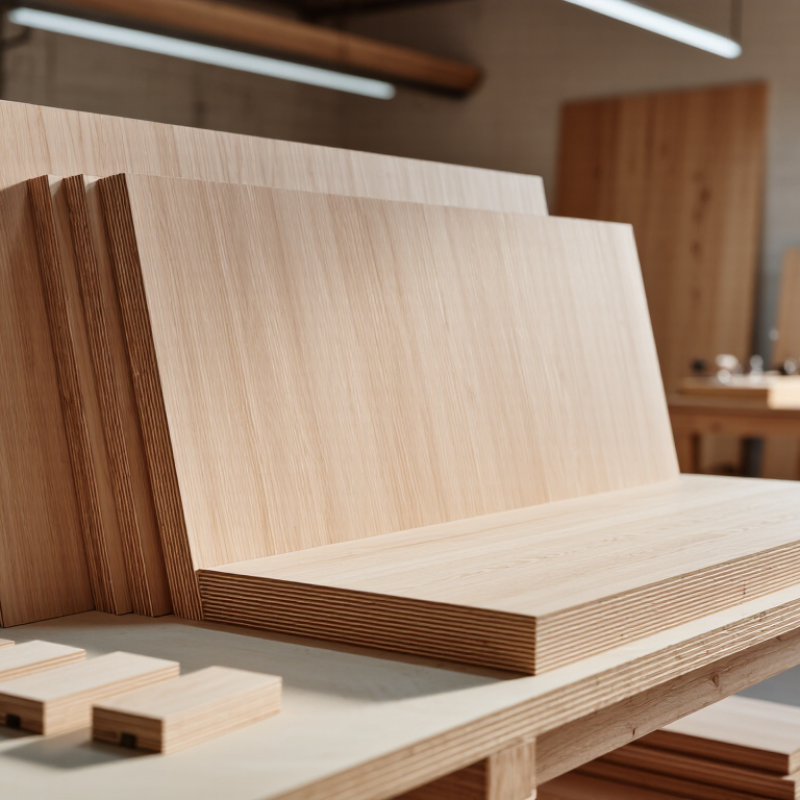
| Core Definition | Manufactured wood panel made from multiple thin veneers bonded with alternating grain directions and controlled quality standards. | Typically uses more consistent veneers, stronger bonding, tighter thickness tolerances, and fewer visible defects than utility-grade plywood. | Provides more predictable strength, appearance, machining, and service life. |
| Veneer Quality | Uniform veneer layers with limited knots, splits, overlaps, core gaps, and patches. | Inspect panel edges and cut samples for continuous layers and minimal internal voids. | Fewer defects improve load transfer, screw holding, cutting accuracy, and surface finish. |
| Surface Grade | Smooth, well-sanded faces with consistent color and minimal repairs or open defects. | Common face-grade systems range from A or AA for clean faces to lower grades with more knots and repairs; grading rules vary by standard. | A cleaner face reduces preparation work for furniture, cabinetry, wall panels, and visible architectural applications. |
| Thickness Tolerance | Thickness remains consistent across the sheet and is suitable for accurate joinery. | A 12 mm panel should be checked against the applicable product standard; actual tolerance depends on construction, sanding, and certification. | Consistent thickness improves flush joints, drawer fit, edge alignment, and installation quality. |
| Dimensional Stability | Balanced cross-lamination and controlled moisture content help limit warping, twisting, and panel movement. | Store panels flat, supported, and protected from direct moisture before installation; no plywood is completely movement-free. | Stable panels maintain alignment and reduce cracking, bowing, and rework. |
| Bonding Performance | Adhesive bonds are continuous and appropriate for the intended exposure class. | Interior, moisture-resistant, and exterior panels require different adhesive and durability classifications; verify the product documentation. | Correct bonding prevents delamination during changes in humidity or exposure to water. |
| Moisture Resistance | Selected according to whether the panel will remain dry, experience intermittent humidity, or face exterior conditions. | “Moisture-resistant” does not automatically mean waterproof or suitable for permanent outdoor exposure. | Matching the panel to the environment prevents premature swelling, edge damage, and bond failure. |
| Strength and Stiffness | Designed with appropriate veneer species, thickness, layer arrangement, and structural grading. | Required performance depends on span, load direction, support spacing, panel thickness, and structural design; do not select by appearance alone. | Adequate stiffness limits sagging, while sufficient strength supports safe load performance. |
| Machinability | Cuts, drills, routes, and sands cleanly with limited tear-out when suitable tools and feed rates are used. | Check edge integrity after machining and use sharp, appropriate blades or router bits. | Better machinability improves production speed and reduces material waste. |
| Formaldehyde and Emissions | Uses an adhesive system and emission classification appropriate for the intended indoor or outdoor application. | Request current third-party test reports or compliance documentation; emission limits differ by jurisdiction and standard. | Lower-emission products support indoor air-quality requirements and project compliance. |
| Certification and Traceability | Supported by clear technical data, production standards, batch information, and, where required, responsible-sourcing certification. | Verify the applicable standard, panel grade, thickness, exposure class, and certificate validity rather than relying only on marketing terms. | Documentation makes quality claims measurable and easier to verify. |
| Best-Fit Applications | Furniture, cabinetry, high-quality joinery, visible wall panels, precision components, and demanding interior or structural work. | Choose the specific panel type and grade according to appearance, loading, moisture exposure, fire requirements, and local building codes. | The best plywood is the one whose verified performance matches the project conditions and budget. |


 Your message must be between 20-3,000 characters!