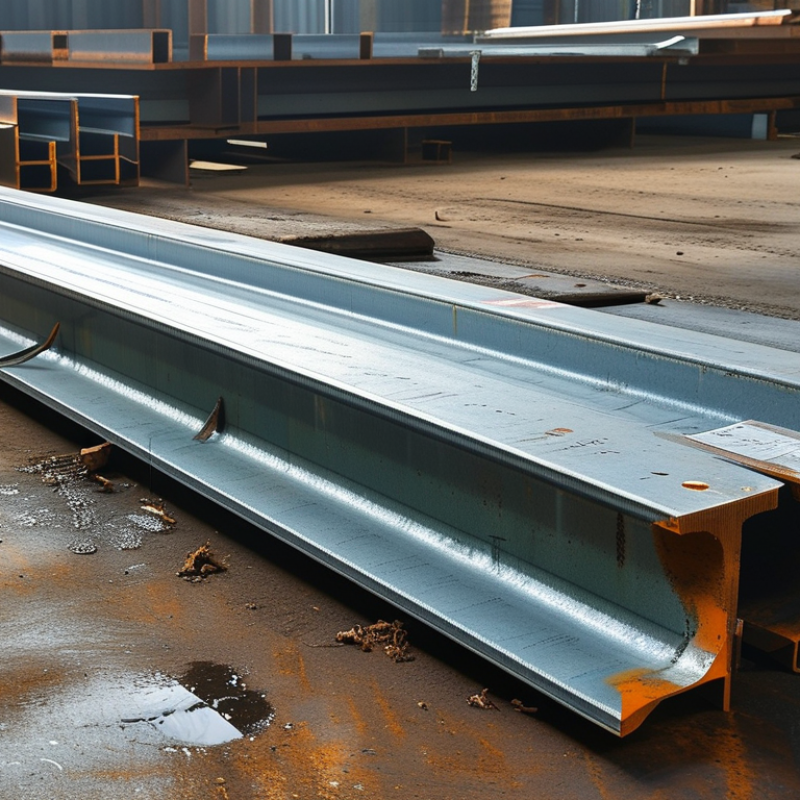
| Beam Section | Section series, nominal depth, flange width, web thickness, flange thickness, and mass per metre. | IPE 100: 100 × 55 × 4.1 × 5.7 mm; approximately 8.1 kg/m
IPE 200: 200 × 100 × 5.6 × 8.5 mm; approximately 22.4 kg/m
IPE 300: 300 × 150 × 7.1 × 10.7 mm; approximately 42.2 kg/m
IPE 400: 400 × 180 × 8.6 × 13.5 mm; approximately 66.3 kg/m | Use these as section references only. Final selection must be based on calculated bending, shear, buckling, deflection, and connection resistance. | EN 10365 for hot-rolled I and H sections; verify dimensions with calibrated callipers and mass with a certified weighbridge. |
| Overall Dimensions | Overall depth h, flange width b, web thickness tw, flange thickness tf, root radius, and beam length. | Commercially available hot-rolled I sections commonly range from approximately 80–600 mm in nominal depth, depending on the section series and regional standard. | Confirm every dimension against the approved drawing. Allow for galvanizing drainage holes, lifting clearances, and dimensional tolerances. | EN 10034 dimensional tolerances; ASTM A6/A6M dimensional and shape tolerances for applicable structural sections. |
| Structural Steel Grade | Yield strength, tensile strength, elongation, impact toughness, and weldability. | S275JR: nominal yield strength 275 MPa for smaller thickness ranges; minimum tensile strength typically 410–560 MPa.
S355JR: nominal yield strength 355 MPa for smaller thickness ranges; minimum tensile strength typically 470–630 MPa.
Actual properties vary with thickness. | Choose the grade from the structural design calculation. Do not substitute S355 for S275, or vice versa, without engineering approval. | EN 10025-2; mill test certificate to EN 10204, normally type 3.1 for supplied structural steel. |
| Galvanizing Coating | Hot-dip galvanized coating thickness, coating uniformity, adhesion, drainage, venting, and repair of damaged areas. | For steel thicker than 6 mm, ISO 1461 commonly specifies a minimum local coating thickness of 70 µm and a minimum mean coating thickness of 85 µm.
For steel from 3 to 6 mm, the corresponding values are commonly 55 µm local and 70 µm mean. | Specify the coating standard and inspection method in the purchase order. Do not judge compliance by appearance alone. | ISO 1461 or ASTM A123/A123M for hot-dip galvanized iron and steel products; ASTM A780/A780M for repair of damaged galvanized coating. |
| Design Loads | Dead load, live load, wind load, snow load, seismic load, point loads, span, support conditions, and load combinations. | There is no universal “correct” I-beam size. A longer span or heavier point load generally requires a greater section modulus, second moment of area, or both. | Check bending stress, shear stress, lateral-torsional buckling, web crippling, bearing, and serviceability deflection before ordering. | Use the governing local structural design code, such as EN 1993-1-1, AISC 360, or the applicable national standard. |
| Connection Type | Bolted, welded, end-plate, fin-plate, angle-cleat, splice, base-plate, or moment connection. | Bolted connections require bolt diameter, grade, hole diameter, edge distance, pitch, gauge, and plate thickness.
Welded connections require weld size, length, process, consumables, and access for pre-treatment and galvanizing. | Avoid drilling or welding after galvanizing where possible. If field modification is unavoidable, remove contamination and repair the exposed steel using an approved zinc-rich system. | EN 1993-1-8 or AISC 360 for connection design; ISO 1461 and ASTM A780/A780M for post-galvanizing repair. |
| Bolt Compatibility | Bolt grade, washer and nut compatibility, coating system, thread condition, tightening method, and galvanic compatibility. | Common structural bolt property classes include 8.8 and 10.9 under ISO 898-1. Hot-dip galvanized bolts and nuts should be supplied as a compatible matched system. | Do not mix incompatible coatings or nuts. Confirm whether the design requires snug-tight, preloaded, or slip-resistant connections. | EN 14399 for high-strength structural bolting assemblies; EN 15048 for non-preloaded structural bolting assemblies; ASTM F3125/F3125M where applicable. |
| Fabrication Before Galvanizing | Cutting, drilling, welding, vent holes, drain holes, temporary attachments, distortion control, and handling points. | Closed or hollow portions require properly positioned vent and drain openings. Long or asymmetrical fabrications may distort during immersion because of thermal stress. | Submit fabrication drawings to the galvanizer before production. Remove weld slag, sharp edges, oil, paint, and marking materials that can interfere with coating. | ISO 14713-2 for design considerations; ISO 1461 for hot-dip galvanized coating requirements. |
| Length and Straightness | Cut length, camber, sweep, twist, end squareness, and straightness after galvanizing. | Typical supply lengths may be 6 m or 12 m, subject to regional availability, transport limits, and the selected section. | Define permitted tolerances before fabrication. Inspect straightness after galvanizing because handling and heating can affect alignment. | EN 10034 or ASTM A6/A6M, as applicable to the selected steel section. |
| Surface Condition | Coverage, continuity, adhesion, excess zinc, runs, sharp protrusions, bare spots, and storage staining. | A galvanized surface may have a bright, dull, or spangled appearance. Colour variation does not automatically indicate coating failure. | Reject exposed steel, excessive uncoated areas, dangerous sharp zinc build-up, or poor adhesion. Minor appearance variation may be acceptable when coating performance is compliant. | ISO 1461 acceptance requirements; ASTM A123/A123M visual and thickness requirements. |
| Inspection and Testing | Coating thickness, section dimensions, steel grade, weld quality, traceability, and quantity. | Use a calibrated magnetic coating-thickness gauge. Record readings at representative locations on the web and both flanges, avoiding obvious runs or drainage edges. | Require inspection records, non-conformance reports, and corrective-action records where applicable. | ISO 1461 for coating inspection; ISO 2178 or ASTM E376 for non-destructive coating-thickness measurement. |
| Supplier Documentation | Mill test certificate, galvanizing certificate, dimensional inspection report, coating-thickness report, delivery note, and heat or batch traceability. | A complete traceability package links the supplied beam to the steel heat number, section size, galvanizing batch, inspection results, and quantity. | Select a supplier able to provide verifiable records before shipment. Match certificate data with markings and delivered quantities. | EN 10204 type 3.1 inspection certificate; ISO 9001 quality-management practices; project-specific inspection and test plan. |
| Supplier Quality Assessment | Production capability, approved procedures, equipment calibration, qualified personnel, subcontractor control, complaint handling, and delivery performance. | Useful evidence includes recent inspection records, calibration certificates, galvanizing process controls, welding qualifications, and documented corrective actions. | Prefer a supplier that accepts independent inspection and provides samples or trial documentation for large or safety-critical orders. | ISO 9001 certification may support quality-system evaluation but does not replace product inspection or engineering verification. |
| Transport and Storage | Beam support spacing, loading restraints, moisture control, ventilation, stacking, and contact with dissimilar metals. | Freshly galvanized members should be stored with spacers and adequate airflow. Persistent wet contact can produce wet-storage staining. | Keep galvanized beams dry and ventilated during storage. Avoid sealed plastic wrapping when condensation cannot escape. | ISO 14713-2 guidance for handling and storage of galvanized products. |
| Final Purchase Specification | Section designation, grade, length, quantity, coating standard, coating thickness requirement, connection details, tolerances, inspection documents, and delivery conditions. | Example specification format: “IPE 300, S355JR, hot-dip galvanized after fabrication to ISO 1461, supplied with EN 10204 type 3.1 certificate and coating-thickness inspection report.” | Make the requirement measurable and contractually clear. Include drawings, revision numbers, inspection hold points, and acceptance criteria. | Applicable structural, steel-product, galvanizing, bolting, welding, and project standards listed in the approved design. |


 Your message must be between 20-3,000 characters!