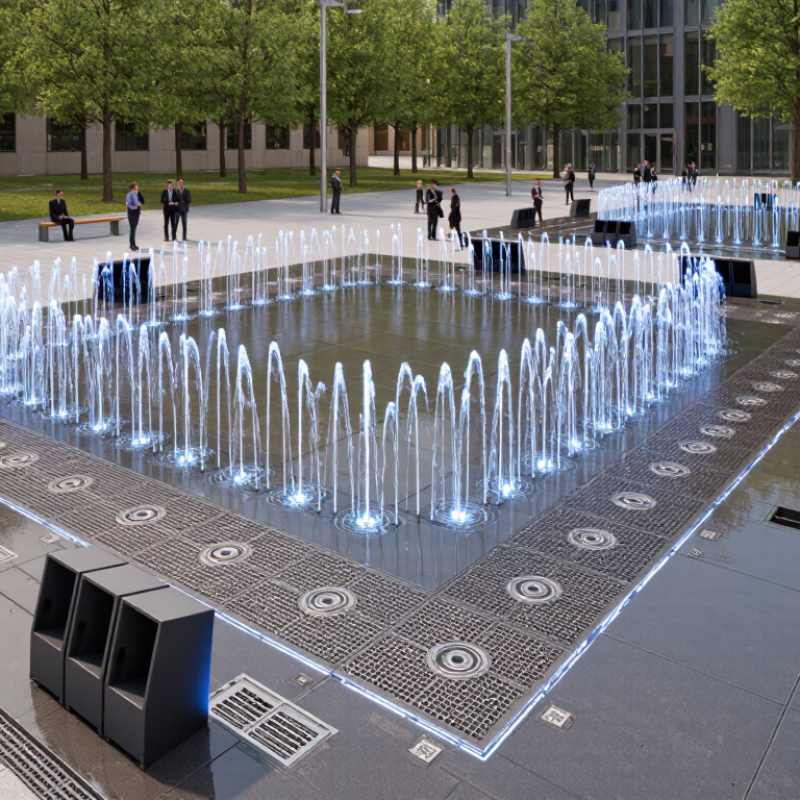
| 1. Define the installation type | Flush jets and deck layout | Confirm whether the project uses flush-mounted nozzles in a paved deck, a covered reservoir below the deck, or another arrangement. State the finished paving level and the intended spray height and pattern. | Request coordinated drawings showing nozzle locations, access panels, pipe routes, drainage points, and the relationship between the fountain and surrounding pavement. |
| 2. Specify grates and walking surfaces | Deck grates, slots, and paving | Identify the materials, finish, load requirements, and intended pedestrian use. Grate openings and surface details should be selected to suit local accessibility, slip-resistance, and safety requirements. | Ask for product data and project-specific details for load capacity, corrosion resistance, surface finish, installation, and safe access for maintenance. Confirm applicable local codes with the design team. |
| 3. Design the recirculating water loop | Reservoir, pumps, and pipework | Provide a hydraulic design based on nozzle flow, operating sequence, pipe losses, reservoir volume, and the number of effects running at the same time. State the expected operating schedule. | Request pump duty points and system calculations rather than selecting a pump by motor rating alone. Check that the design includes suitable water-level control, make-up water, overflow, and drain arrangements. |
| 4. Plan water quality and filtration | Filters, treatment, and water management | Specify filtration and water-treatment provisions appropriate to the water source, climate, usage, and local health and environmental requirements. | Confirm how filters are accessed and cleaned, how water quality is monitored, and how treatment, backwash, and discharge are managed. Establish a maintenance plan with the supplier. |
| 5. Coordinate music, lighting, and controls | Show control and electrical systems | List the required audio inputs, lighting effects, show sequences, operating modes, and control interfaces. Identify the power supply and communication requirements for the project location. | Request an interface schedule and a sequence-of-operations document. Have qualified local professionals verify electrical protection, bonding, earthing, and installation against applicable regulations. |
| 6. Check drainage and climate conditions | Site drainage and seasonal operation | Provide site information such as rainfall, ambient temperature range, wind exposure, groundwater conditions, and any freeze or seasonal shutdown requirements. | Confirm where splash water and stormwater go, how the area drains when the fountain is off, and what procedures are needed for shutdown, winterization, or restart. |
| 7. Compare lifecycle support | Access, spare parts, and documentation | Include routine inspection, cleaning, filter service, pump access, consumables, and expected operating needs in the ownership plan. | Request as-built drawings, equipment schedules, operation and maintenance manuals, recommended spare parts, warranty terms, and a clear process for technical support. |


 Your message must be between 20-3,000 characters!