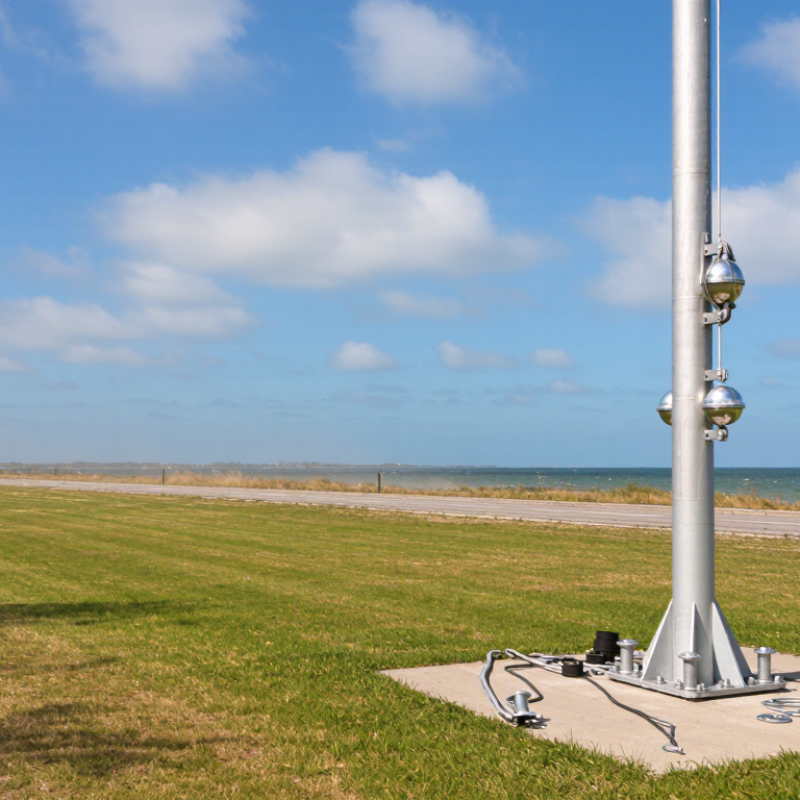
| Design standard scope | EN 1991-1-4 addresses wind actions on structures. It is not a complete flag-pole product standard and should be applied with the relevant National Annex. | Wind exposure, terrain category, altitude, topography, seasonality, and local national parameters can change the required pole strength and foundation design. | Structural calculation package identifying the adopted Eurocode clauses, National Annex, wind region, terrain category, and design assumptions. | Do not approve a pole using only a generic wind-speed statement. |
| Wind-load input | The basic velocity pressure relationship is q = ½ρv², where ρ is air density and v is wind speed. EN 1991-1-4 design procedures also use factors for exposure, turbulence, orography, and structural response. | Wind pressure increases approximately with the square of wind speed; a modest increase in specified wind speed can significantly increase bending demand. | Project wind map, site coordinates, terrain classification, topographic assessment, and calculation of peak or design velocity pressure. | Specify site wind criteria before comparing pole quotations. |
| Pole geometry | Record overall height, shaft outside diameter, wall thickness, taper, number of sections, joint arrangement, flag area, flag porosity, and hardware projection. | Projected flag area and fittings affect drag and overturning moment. Section joints and local holes can govern fatigue or buckling performance. | Dimensioned drawings, mass schedule, connection details, weld details, and installation instructions. | Reject quotations that state only pole height without design geometry. |
| Anchor-bolt standard | ASTM F1554 covers anchor bolts and specifies grades including 36, 55, and 105. It does not specify the complete flag-pole design or foundation. | The anchor-bolt grade must be compatible with the base plate, nuts, washers, embedment, grout, concrete, and calculated tension and shear forces. | Mill test certificate, grade marking or traceability records, bolt diameter and length, thread details, nut and washer specification, and coating information. | Treat ASTM F1554 as an anchor-bolt requirement, not as proof that the pole itself complies with a structural standard. |
| ASTM F1554 Grade 36 | Minimum yield strength: 36 ksi (approximately 248 MPa). Minimum tensile strength: 58 ksi (approximately 400 MPa). | A lower-strength anchor option that may be suitable where the engineered demand and connection design permit it. | Compliant material certificate and inspection records linked to the supplied lot. | Use only when confirmed by the connection and foundation calculations. |
| ASTM F1554 Grade 55 | Minimum yield strength: 55 ksi (approximately 380 MPa). Minimum tensile strength: 75 ksi (approximately 517 MPa). | Provides higher specified strength than Grade 36 and is commonly considered for more demanding anchor assemblies. | Material test report, chemical and mechanical results where required, and dimensional inspection report. | A practical baseline to evaluate when the design requires additional anchor capacity. |
| ASTM F1554 Grade 105 | Minimum yield strength: 105 ksi (approximately 724 MPa). Minimum tensile strength: 125 ksi (approximately 862 MPa). | High-strength anchors may reduce required diameter in some designs, but connection ductility, installation control, and pretension requirements still need engineering review. | Grade-specific mill certificate, traceability, hardness or testing records where specified, and installation method statement. | Do not select solely because it has the highest strength; verify the complete connection design. |
| Foundation and soil | Foundation design should account for overturning moment, shear, uplift, concrete strength, reinforcement, soil bearing, sliding, rotation, and frost or groundwater conditions where applicable. | A structurally adequate shaft can still fail if the foundation or soil assumptions are unsuitable for the installation site. | Geotechnical parameters, foundation drawings, reinforcement schedule, concrete specification, and installation inspection plan. | Make foundation responsibility explicit in the purchase contract. |
| Corrosion protection | Define material, coating system, coating thickness, surface preparation, repair method, drainage, and compatibility between dissimilar metals. | Marine, industrial, de-icing-salt, and high-humidity environments can shorten service life if the coating system is not matched to exposure. | Coating specification, inspection report, thickness readings, repair procedure, and environmental exposure classification. | Compare lifecycle protection, not only initial purchase price. |
| Incoterms 2020: EXW | The seller places the goods at the named premises. The buyer generally arranges loading, export formalities, carriage, insurance, import clearance, and delivery. | The buyer carries substantial logistics and export-compliance responsibilities, which may be difficult when sourcing cross-border. | Named place, loading responsibility, export documentation process, pickup schedule, and cost allocation. | Use only when the buyer can manage origin-country logistics and export procedures. |
| Incoterms 2020: FCA | The seller delivers the goods to the buyer's nominated carrier at the named place and completes export clearance where applicable. | FCA can provide clearer allocation of export responsibility than EXW and is suitable for containerized or multimodal shipments. | Exact named place, handover point, packaging requirements, transport booking, and export documents. | Often a balanced option when the buyer controls international freight. |
| Incoterms 2020: FOB | For sea or inland-waterway transport, the seller delivers when the goods are loaded on board the vessel at the named port of shipment; risk transfers at that point. | Useful for traditional port-to-port cargo, but it is not the preferred rule for container shipments that are handed to a terminal before loading. | Named port, vessel booking, export clearance, loading confirmation, and marine insurance decision. | Choose only when the shipment structure genuinely matches port loading on board. |
| Incoterms 2020: CIF | The seller pays cost, insurance, and freight to the named destination port, but risk transfers when the goods are loaded on board at the shipment port. The rule is for sea or inland-waterway transport. | The buyer should confirm the insurance level and understand that freight payment by the seller does not mean the seller retains transit risk. | Insurance certificate, bill of lading, named destination port, freight terms, and import-clearance responsibility. | Check whether the contracted insurance coverage is sufficient for the cargo value and route. |
| Incoterms 2020: DAP / DDP | Under DAP, the seller delivers at the named destination ready for unloading and the buyer handles import clearance. Under DDP, the seller also handles import clearance, duties, and taxes, subject to local legal ability. | These terms can simplify delivery planning but may increase the quoted price and create tax or customs issues for the seller and buyer. | Named delivery location, unloading equipment, import registration, duty and tax allocation, and customs documentation. | Use DAP when the buyer will manage import; use DDP only after confirming the seller can legally perform import obligations. |
| Final approval gate | Approve only after structural calculations, material certificates, coating records, foundation documents, packing details, inspection criteria, and the selected Incoterm are consistent with the destination-country requirements. | Global compliance depends on the complete supply chain and installation scope, not on one standard or one certificate. | Signed technical submittal, inspection and test plan, approved drawings, commercial contract, packing list, and agreed shipping documents. | Release production and shipment only after all open compliance items are closed. |


 Your message must be between 20-3,000 characters!