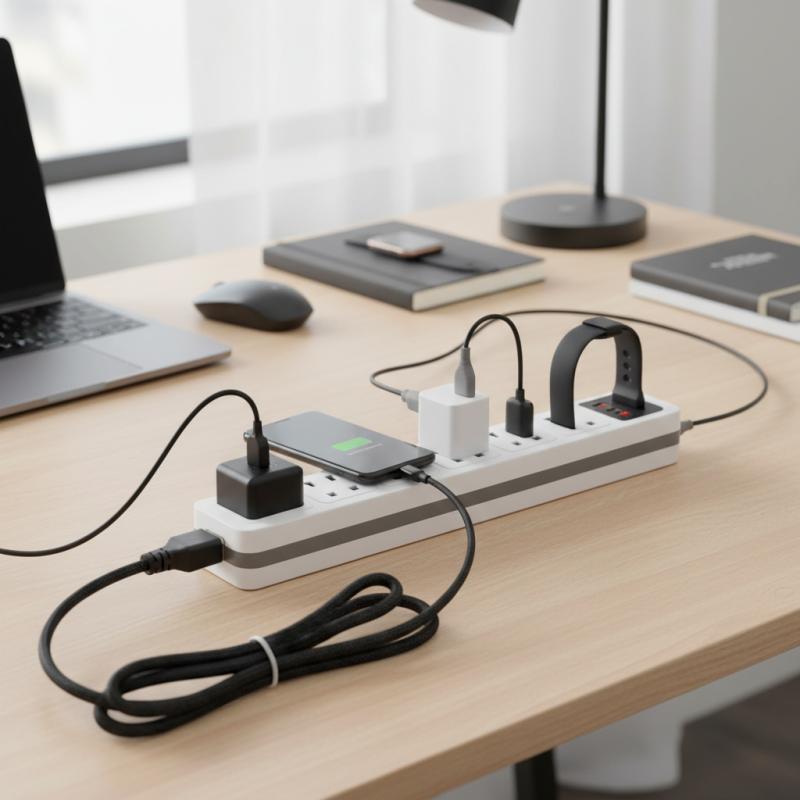
How to Choose the Best Power Strip for Your Needs?
Power Strips are essential tools in our daily lives. They help us manage multiple devices with ease. However, choosing the right one can be challenging. Many options are available, each with unique features and specifications. A suitable power strip should provide safety, efficiency, and flexibility.
When selecting a power strip, consider your specific needs. Do you need USB ports for charging devices? Is surge protection necessary for your setup? Evaluating your requirements can lead to better choices. The complexities of electrical demands can create confusion. This confusion often leads to mistakes that may result in damaged devices or electrical hazards.
Understanding the technical aspects is critical. Read reviews and compare ratings from trusted sources. Not all power strips are created equal; some may not offer adequate protection. It’s essential to invest time in research. This ensures your chosen power strip will serve you well in the long run. Remember to reflect on your choices for better future decisions.
Understanding Power Strip Types: Basic vs. Advanced Features
When selecting a power strip, it's essential to understand the varying features available. Power strips can be broadly categorized into basic and advanced models. Basic power strips typically offer just multiple outlets, often lacking in safety features. They may not provide surge protection, leaving devices vulnerable to spikes. According to a study by the Electrical Safety Foundation International, nearly 80% of electrical fires stem from faulty equipment. This statistic emphasizes the importance of opting for safer products.
Advanced power strips come with enhanced features. They often include surge protection, USB charging ports, and even individual outlet switches. Advanced models allow for better energy management. A report from the U.S. Department of Energy notes that energy-efficient power strips can save up to $100 yearly in electricity costs. This is valuable for both the environment and your wallet.
Consider your unique needs. If your setup requires multiple devices, a power strip with surge protection is advisable. However, some might find that a basic model suffices. Reflecting on your usage can lead to selecting the right type. Balancing cost against feature sets is crucial for making an informed decision.
Evaluating Surge Protection Ratings: Joules and Clamping Voltage Explained
When selecting a power strip, it's vital to understand surge protection ratings. Two key metrics are Joules and clamping voltage. Joules measure the energy absorption capacity of a power strip. A higher Joules rating means better protection against surges. For instance, a power strip with a rating above 1000 Joules offers considerable safeguarding for your devices.
Clamping voltage indicates the threshold at which the surge protection kicks in. A lower clamping voltage generally offers better protection. If your power strip has a clamping voltage of 330V, it will react faster to surges compared to one rated at 400V. This quick response can significantly reduce the risk of damage to your electronics.
Tips: Always check the Joules rating before making a purchase. Consider your devices’ worth and choose a power strip that matches that value. Remember, even a high-end power strip can fail if not used properly. Regularly inspect for signs of wear, as they can diminish surge protection effectiveness. Ignoring this can lead to costly damage.
Assessing Outlet Count and Spacing: Meeting Your Device Needs
When choosing a power strip, outlet count and spacing are critical. Consider how many devices you'll plug in. Smartphones, laptops, and gaming consoles add up quickly. Each device needs its space to avoid overcrowding. A strip with too many closely spaced outlets can lead to a cluttered setup. This mess may block other outlets.
Evaluate the types of devices you use. Bulkier plugs can occupy more space. Some strips offer wider spacing for these larger adapters. Think about your workspace. If it's tight, you might need a compact design. However, too small a design might compromise capacity.
It's also essential to account for future needs. You may add new devices later. A power strip with extra outlets gives room for growth. Reflect on your current setup. Are you often repurposing outlets? If yes, it might be time for a change. Balancing space and functionality ensures your needs are met effectively.
Exploring Additional Features: USB Ports and Smart Technology Insights
Power strips have evolved beyond mere electricity distribution. Many now feature USB ports, catering to the growing demand for charging devices. These ports allow quick access for smartphones, tablets, and headphones. Consider the total wattage and charging capacity before making a choice. Some power strips may not support all devices simultaneously, which can lead to disappointments.
Smart technology integration is another aspect to consider. A power strip with smart capabilities can monitor energy usage. You may find models that enable remote control via apps. These features can enhance convenience but come with potential connectivity issues. The dependency on Wi-Fi could be a drawback in less reliable networks.
Selecting the right power strip requires careful thought. Think about your unique requirements. Ask yourself if extra features truly add value. In many cases, the basics might suffice. Reflect on your typical energy habits, allowing for a more informed choice. A well-chosen power strip should serve your needs without complicating your setup.
Safety Certifications: Importance of UL and FCC Standards in Power Strips
When choosing a power strip, safety certifications matter. The UL (Underwriters Laboratories) and FCC (Federal Communications Commission) standards are crucial. UL ensures that the device has undergone rigorous testing for safety. Products with UL certification meet specific electrical safety requirements. This reduces the risk of electrical fires and equipment damage.
FCC certification confirms that the power strip complies with electromagnetic interference standards. This helps protect your devices from signal interference. Basic testing can expose some flaws, but only certified products guarantee a comprehensive safety assessment. High-risk environments should always prioritize certified strips.
Not all power strips are equal. Some may look reliable but lack these essential certifications. Inexperience in selecting a power strip can lead to unsafe choices. Always check for these markings before purchasing. Products without them might be cheaper, but cost savings can lead to significant hazards. Your home and devices deserve safety first.