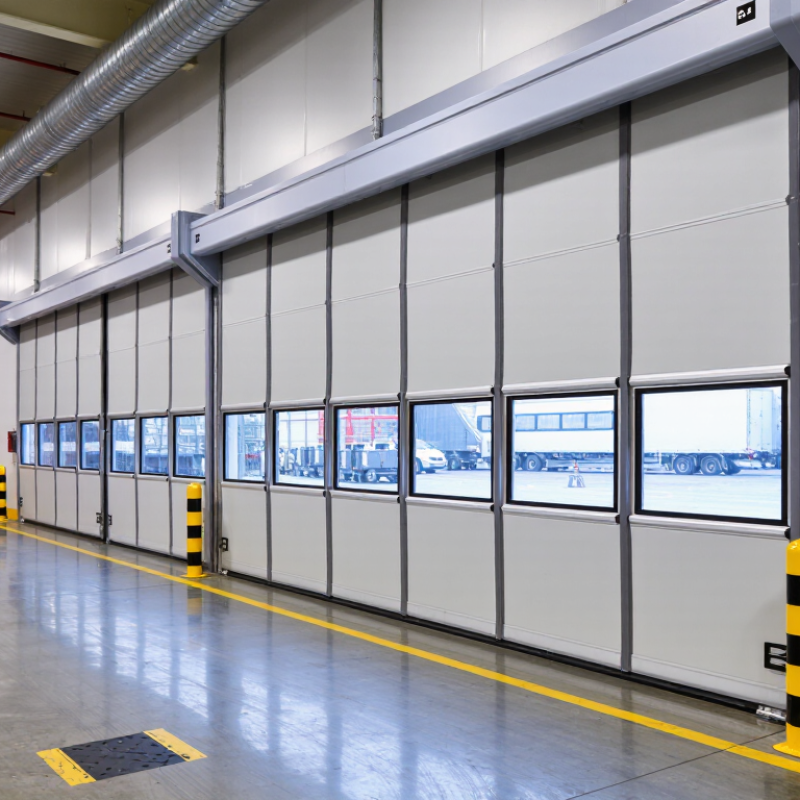
| Interior Flexible Fabric Door | Warehouses, production areas, logistics corridors, and pedestrian or forklift routes | Indoor areas with moderate air movement and frequent traffic | Approximately 0.8–2.0 m/s, depending on size and control system | Provides limited thermal separation; normally selected for ambient or mildly conditioned spaces | Designed mainly for indoor use; fabric strength and bottom-bar design determine impact resistance | Clear viewing panels can improve visibility between traffic zones | Photoelectric sensors, safety edges, emergency stop, warning lights, and controlled closing | Choose when cycle speed and traffic flow are more important than high insulation or outdoor wind resistance |
| Exterior Wind-Resistant Fabric Door | Loading bays, distribution centers, vehicle entrances, and building-to-building connections | Outdoor-facing openings exposed to wind, rain, dust, and changing weather | Approximately 0.8–1.5 m/s, subject to opening dimensions and wind load | Helps reduce air exchange but is not a replacement for a high-insulation cold-storage door | Reinforced curtains, stronger guides, and wind-rated construction are important; wind classification must be checked for the site | Vision panels or transparent curtains may reduce collision risk at busy entrances | Safety photocells, bottom sensing edge, flashing beacon, audible warning, and manual release | Specify the required wind pressure, exposure category, opening size, and traffic frequency before selection |
| Self-Resetting Flexible Door | Forklift routes, manufacturing cells, warehouses, and areas with frequent accidental contact | Indoor or sheltered locations with repeated vehicle traffic | Approximately 0.8–1.5 m/s | Usually suitable for ambient conditions; sealing and material grade vary by temperature range | Designed to return the curtain to its guides after many minor impacts, reducing downtime | Transparent sections and high-visibility curtain colors can support safer traffic separation | Impact detection, photocells, safety edges, warning signals, and emergency access release | Choose this type where minor impacts are likely and rapid return to service is valuable |
| Insulated Rigid Rapid Door | Energy-sensitive warehouses, clean production areas, temperature-controlled rooms, and high-cycle exterior openings | Indoor or exterior openings requiring improved sealing and panel stability | Approximately 0.5–1.5 m/s, depending on panel weight and design | Provides better thermal performance than a single flexible curtain; insulated panel construction and perimeter seals are key | Rigid panels and stronger guides offer good stability; structural and wind requirements must be verified | Vision panels may be available, but visibility is generally lower than with a transparent fabric curtain | Photoelectric sensors, pressure-sensitive edges, controlled restart, emergency stop, and manual opening provision | Select when energy control, sealing, and robust daily operation justify a higher initial investment |
| Cold-Room Insulated Rapid Door | Chilled storage, food processing, pharmaceutical storage, and refrigerated dispatch areas | Positive-temperature refrigerated rooms, commonly around 0°C to 8°C, subject to product and process requirements | Approximately 0.8–2.0 m/s | Insulated curtain or panel, heated seals where required, and minimized open time help limit condensation and temperature loss | Suitable for controlled indoor traffic; hardware must tolerate moisture, washdown, and low temperatures | Vision panels and traffic lights can improve safety around cold-room entrances | Anti-entrapment sensing, emergency release, low-temperature-rated controls, and slip-resistant floor interfaces | Confirm the required U-value, humidity level, washdown method, condensation risk, and hygiene standard |
| Freezer Rapid Door | Frozen-food stores, deep-freeze rooms, and temperature-controlled distribution areas | Freezer environments, often below 0°C and potentially around −18°C or lower | Approximately 0.8–2.0 m/s, depending on the freezer design and door dimensions | Requires substantial insulation, heated or protected seals, moisture control, and a specification suitable for the actual low temperature | Designed for frequent cycles in demanding conditions; ice formation and condensation must be managed | Visibility may be reduced by frost; sensors, signals, and traffic rules become especially important | Low-temperature sensors, emergency release, anti-freeze measures, safety edges, and suitable control enclosures | Use only a system specifically rated for the minimum room temperature and expected humidity conditions |
| Hygienic Stainless-Steel Rapid Door | Food, beverage, pharmaceutical, medical, and other hygiene-controlled production areas | Frequent cleaning, washdown, moisture, and controlled contamination environments | Approximately 0.8–1.5 m/s | Thermal performance depends on curtain or panel construction; seals and materials should suit the process temperature | Corrosion-resistant hardware and smooth, cleanable surfaces are important; avoid unnecessary dirt traps | Vision panels, floor markings, and traffic lights can improve separation between clean and less-clean zones | Non-contact sensors, emergency stop, cleanable safety devices, and controlled closing force | Check material compatibility, ingress protection, cleaning chemicals, drainage, and the required hygienic design level |
| Cleanroom Rapid Door | Pharmaceutical manufacturing, electronics, medical-device production, laboratories, and controlled environments | Areas requiring managed air movement, pressure differentials, and low particle generation | Approximately 0.5–1.5 m/s, with speed selected to support the room-pressure strategy | Perimeter sealing and controlled opening time help reduce air exchange; insulation depends on the door construction | Usually installed indoors; door rigidity and sealing should match the room pressure differential | Viewing panels can support visual confirmation while maintaining separation between rooms | Interlocks, access control, monitored sensors, emergency release, and fail-safe operation where required | Coordinate the door with HVAC design, pressure cascade, room classification, cleaning procedures, and validation requirements |
| High-Cycle Heavy-Duty Fabric Door | Automotive plants, parcel hubs, large warehouses, and continuous-shift manufacturing facilities | High-frequency indoor or sheltered operation with substantial daily cycle counts | Approximately 1.0–2.0 m/s | Normally intended for ambient spaces; optional sealing or insulated construction may improve energy control | Reinforced components, durable guides, and serviceable parts are important for high cycle rates | Large vision areas and warning lights support fast-moving vehicle traffic | Redundant sensing, safety edges, emergency stop, cycle monitoring, and obstruction detection | Prioritize duty cycle, service access, replacement-part availability, and control-system diagnostics |
| Fire-Rated or Smoke-Control Rapid Door | Specialized industrial, commercial, and compartmentation applications where fire or smoke requirements apply | Locations governed by local fire, life-safety, and building regulations | Varies by certified design; rapid operation may be combined with controlled emergency closing | Thermal and smoke performance must be based on the tested and certified assembly, not only the door curtain | Must be installed as part of a compliant fire or smoke-control strategy | Visibility is secondary to certified fire and smoke performance | Fire alarm interface, emergency release, backup power or fail-safe response, and compliant safety controls | Specify only with documented local certification, installation requirements, inspection procedures, and authority approval |


 Your message must be between 20-3,000 characters!