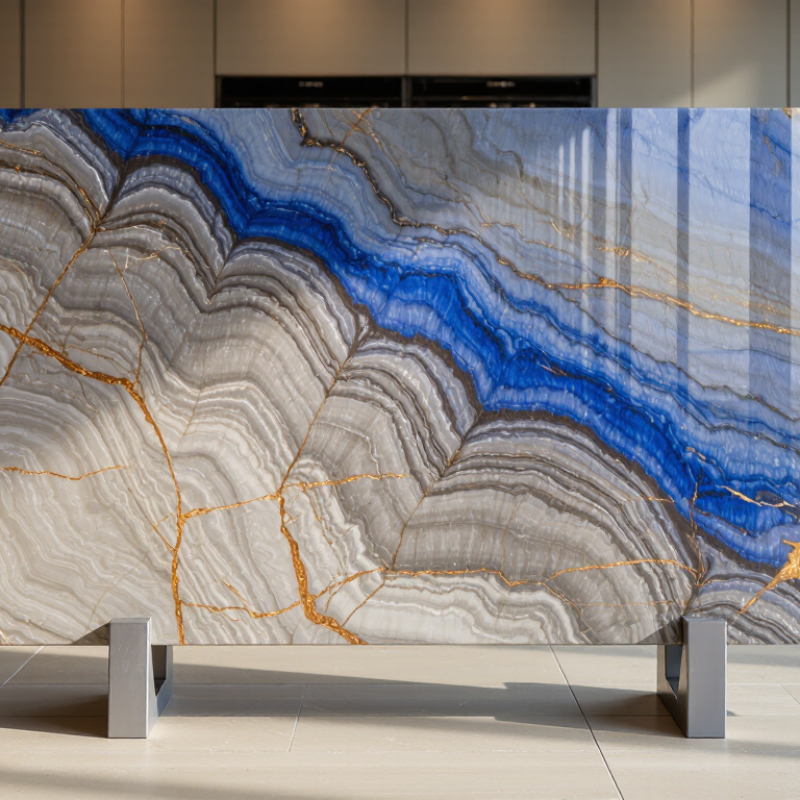
| Stone Identification | Confirm that the material is sold and documented as natural quartzite, not quartz-based engineered surfacing or another blue natural stone. | Material identity should appear consistently on the quotation, sample approval, slab tags, and technical documentation. | Material: Azul Macaubas quartzite
Finish: __________
Slab lot or bundle: __________ | Approve the exact slab or slab lot whenever color, veining, and movement are critical to the design. |
| Visual Variation | Evaluate the background color, blue veining, mineral movement, fissures, and natural inclusions under the intended lighting. | Natural stone is inherently variable; a small sample cannot represent every slab. | Approved slab photographs: Yes / No
Lighting reviewed: Daylight / Artificial / Both | Use a layout drawing for bookmatching, vein direction, cutouts, and visible areas before fabrication. |
| Slab Thickness | Confirm nominal thickness and the finished thickness after polishing or edge fabrication. | Common nominal formats: 20 mm and 30 mm
Actual thickness must be measured on the supplied slab. | Nominal thickness: ____ mm
Measured thickness: ____ mm | Coordinate thickness with cabinet support, edge details, sink installation, and transportation requirements. |
| Compressive-Strength Test | Request a laboratory report for the same material type or, preferably, the same quarry lot and production batch. | ASTM C170/C170M is the Standard Test Method for Compressive Strength of Dimension Stone. It is a test method, not a universal minimum-strength requirement for every project. | Test report number: __________
Laboratory date: __________
Tested value: ____ MPa / ____ psi | Compare the reported result with the structural or project specification. Do not substitute a generic online value for a lot-specific report. |
| ASTM C170 Test Condition | Check whether specimens were tested dry, saturated, or under another condition stated in the report. | Strength results are meaningful only when the specimen condition, loading direction, specimen dimensions, and number of specimens are documented. | Condition: Dry / Saturated
Loading direction: Parallel / Perpendicular
Specimens tested: ____ | Compare results only when the test conditions and reporting basis are equivalent. |
| Unit Conversion | Use consistent units when comparing the laboratory report with the project specification. | 1 MPa = 145.038 psi
1 psi = 0.00689476 MPa | Reported unit: MPa / psi
Converted value, if needed: __________ | Record the original reported value as well as any converted value to prevent transcription errors. |
| Water Absorption and Sealing | Review the stone’s absorption data and perform a sealer compatibility test on an offcut or concealed area. | There is no single universal sealer or fixed reapplication interval for all quartzite. Porosity and sealer performance vary by stone and product. | Absorption report available: Yes / No
Sealer test result: Pass / Fail
Product and application date: __________ | Choose a penetrating sealer only after confirming compatibility, appearance, curing time, and intended use with the sealer instructions. |
| Sealer Verification | Check resistance to likely liquids such as water, cooking oil, coffee, and acidic beverages using a controlled test on a remnant. | A temporary darkening or ring after liquid exposure does not by itself establish a standardized pass/fail result. | Test liquid: __________
Exposure time: ____ minutes
Observed change: None / Darkening / Stain / Other | Use the test result to select the maintenance plan; do not assume that sealing makes the stone stain-proof or acid-proof. |
| Routine Cleaning | Define the daily cleaning method for the completed installation. | Use a pH-neutral stone cleaner, clean water, and a soft cloth or non-abrasive pad. Remove spills promptly. | Cleaner approved: Yes / No
Cleaning frequency: Daily / As needed | Avoid abrasive powders, scouring pads, and unapproved acidic or highly alkaline chemicals. |
| Acid Exposure | Identify contact risks from lemon juice, vinegar, wine, acidic cleaners, and other low-pH substances. | Quartzite is generally more acid-resistant than calcite-rich marble, but mineral composition and surface finish can vary. Acid exposure may still affect sensitive minerals, sealers, or contaminants. | High-risk areas: Kitchen / Bar / Bathroom / Exterior
Spill-response plan: Yes / No | Wipe acidic spills quickly and never use acidic products for routine cleaning unless specifically approved for the surface. |
| Heat and Thermal Shock | Confirm the intended use near cooktops, fireplaces, outdoor kitchens, or areas exposed to rapid temperature changes. | Natural stone can be affected by thermal shock, existing fissures, resin treatments, and uneven heating. | Application: Interior / Exterior / Wet Area / Fireplace
Heat-protection plan: __________ | Use trivets or heat barriers, avoid sudden temperature changes, and follow the fabricator’s installation requirements. |
| Fabrication and Support | Review cutouts, overhangs, seam locations, edge profiles, and cabinet or substrate support before fabrication. | Compressive strength alone does not determine resistance to impact, bending, cutout cracking, or installation damage. | Fabrication drawing approved: Yes / No
Support and overhang review: Complete / Pending | Have a qualified fabricator evaluate unsupported spans, narrow sections, sink cutouts, and visible fissures. |
| Acceptance Before Installation | Inspect slabs for cracks, unstable fissures, edge damage, resin-filled areas, staining, and unacceptable visual variation. | Inspection should occur before cutting because fabrication can make defects more difficult to document or resolve. | Inspection date: __________
Accepted by: __________
Defects recorded: Yes / No | Photograph and document any disputed condition before fabrication, installation, or sealing. |
| Maintenance Schedule | Set a maintenance schedule based on use, exposure, absorption behavior, and the selected sealer’s instructions. | Sealer durability is application- and use-dependent; there is no scientifically universal annual resealing rule for every quartzite installation. | Routine review interval: ____ months
Re-sealing trigger: Water absorption / Staining / Scheduled review | Re-test the surface when performance changes instead of resealing automatically without checking compatibility and condition. |


 Your message must be between 20-3,000 characters!