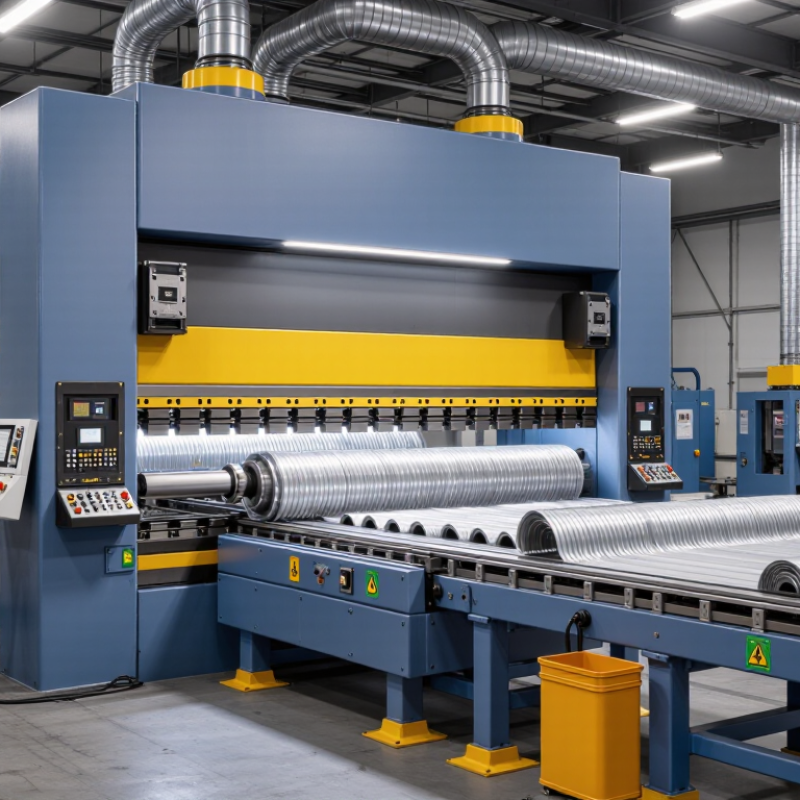
| 1 | Tooling precision and repeatability | Look for documented die and guide-system repeatability of approximately ±0.02–0.05 mm for critical forming features. | Accurate tooling helps maintain consistent fin pitch, height, louver geometry, and alignment during long production runs. | Review dimensional inspection reports, die-maintenance records, and sample parts measured with a calibrated optical or coordinate measuring system. |
| 2 | Supported aluminum strip range | Confirm that the machine supports the required alloy, temper, strip width, and thickness. Common heat-exchanger fin stock is often about 0.08–0.30 mm thick, but the actual range depends on the product. | A machine that is too lightly or heavily rated can cause unstable feeding, excessive burrs, tool wear, or material cracking. | Compare the machine specification with the material mill certificate and run a trial using the exact alloy, temper, thickness, and width. |
| 3 | Fin geometry and surface quality | Define allowable variation for fin height, pitch, louver angle, burr height, and surface damage. A useful starting target is less than 5% pitch variation and no visible tearing or crushed sections. | Uniform fins provide predictable airflow and heat-transfer performance while reducing assembly problems and rejection rates. | Inspect a statistically representative sample using optical measurement, profile projection, burr checks, and visual inspection under consistent lighting. |
| 4 | Feed accuracy and strip control | For precision fin production, evaluate feed accuracy around ±0.05–0.10 mm per feed cycle, with stable uncoiling and tension control. | Inaccurate feeding can create pitch drift, material buckling, die misalignment, and inconsistent cut-off lengths. | Measure feed length over at least 100 consecutive cycles and check the results at startup, steady state, and near coil end. |
| 5 | Production speed and usable output | Many fin presses operate broadly in the range of 60–180 strokes per minute. Compare usable parts per minute rather than maximum empty-machine speed. | Higher nominal speed is valuable only when fin quality, uptime, changeover time, and scrap remain within acceptable limits. | Request a production trial that records strokes per minute, good pieces per hour, downtime, changeover duration, and scrap percentage. |
| 6 | Press rigidity, vibration, and safety | Prioritize a rigid frame, stable slide guidance, overload protection, guarding, interlocks, emergency stops, and compliance with applicable machinery-safety requirements. | Low vibration improves tool life and dimensional stability, while effective safeguards reduce operator exposure to moving tooling and strip edges. | Observe the machine at operating speed, review risk-assessment documentation, test safety circuits, and inspect vibration or abnormal noise during a trial run. |
| 7 | Changeover, maintenance, and total operating cost | Evaluate quick-change tooling, accessible lubrication points, spare-part availability, and a documented preventive-maintenance schedule. Track setup time and scrap; a practical internal goal is to keep avoidable scrap below 2–3% after process stabilization. | Shorter changeovers and predictable maintenance improve equipment availability and reduce the real cost per acceptable fin. | Time a complete product changeover, review maintenance intervals, calculate energy and tooling consumption, and compare total cost per good part. |


 Your message must be between 20-3,000 characters!