| Solid-core 3D panel | Dense, solid cross-section with a molded or machined relief face | Wood flour or fiber blended with a thermoplastic resin and processing additives; surface may be embossed, brushed, or coated | Often supplied as individual boards or decorative panels; thickness and face width vary by product | Interior feature walls and areas where a substantial panel edge is preferred | Confirm weight, fixing method, expansion allowance, and whether the finish is factory-applied |
| Hollow-core 3D panel | Hollow chambers or ribs reduce material use and overall panel weight | WPC body with a textured, embossed, or film-finished face | May use interlocking edges or a tongue-and-groove connection; cavity layout differs among products | Interior decorative cladding where a lighter panel is useful | Review edge support, fixing locations, impact requirements, and suitability for the intended exposure |
| Co-extruded panel | Core and outer cap are formed as joined layers during extrusion | WPC core with a polymer-rich protective cap; surface options can include wood-grain embossing or a matte texture | Available in board or panel formats; profile dimensions are product-specific | Applications where a capped surface is specified, including some sheltered exterior uses | Check cap coverage, color consistency, UV and weathering test data, and the stated installation conditions |
| Fluted or linear-rib profile | Repeated raised ribs and recessed channels create a directional 3D appearance | Embossed, brushed, or coated WPC surface; rib depth and spacing affect the shadow pattern | Commonly installed as vertical or horizontal slats, depending on the fixing system | Feature walls, reception areas, and interior partitions | Check whether end trims and matching corner details are available and how the profile should be oriented |
| Wave or curved profile | Continuous curved relief across the panel face | Textured WPC surface; finishes may be printed, coated, or molded into the face | Profile depth and wave pitch vary; align adjacent pieces according to the installation guide | Decorative walls where a softer, flowing surface effect is desired | Request a physical sample to assess the relief, color, and appearance under the project’s lighting |
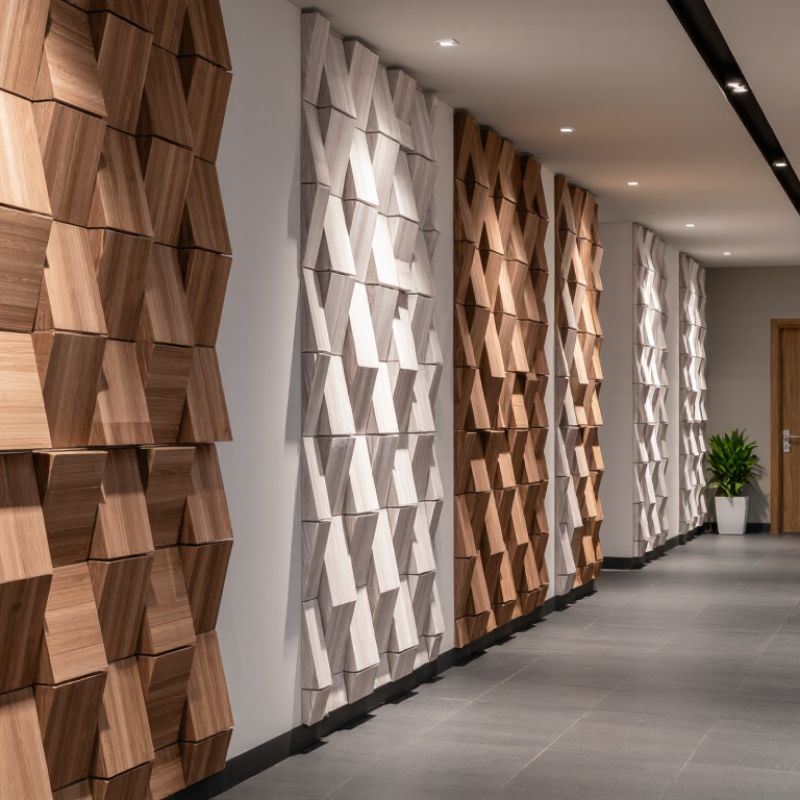
| Geometric or block-relief profile | Repeated square, rectangular, or angular raised forms | May use a molded texture or an applied finish; seams can be more visible on strongly patterned faces | Panelized formats may simplify layout, but module sizes are not standardized | Interior accent walls and selected commercial decorative installations | Confirm pattern repeat, seam alignment, allowable trimming, and the number of panels needed per area |
| Material composition | Composition and layer arrangement differ among formulations | Typically combines wood-derived flour or fiber, a thermoplastic such as PVC, PE, or PP, and additives; exact proportions are manufacturer-specific | Ask for the stated resin type and product construction rather than assuming all WPC is alike | Useful for comparing products with similar visual finishes | Request composition information, safety documentation, and relevant emissions or regulatory declarations for the destination market |
| Panel thickness and size | Panel dimensions depend on the extrusion, molding, or fabrication method | Decorative relief may add to the overall face depth | No single global standard; verify nominal and actual dimensions, tolerances, and coverage per piece | All projects, especially those requiring coordinated trim or substrate details | Check usable coverage, joint dimensions, packaging quantity, and whether stated dimensions include the relief |
| Thermal movement and installation | Panels are fixed to a suitable substrate or support system, with joints arranged as specified | Thermoplastic-containing products can expand or contract with temperature changes | Fixing may use clips, screws, or compatible adhesive, depending on the product and substrate | Interior installation and, only where specified, exterior cladding | Follow the product’s expansion gaps, support spacing, ventilation, substrate, and fastening instructions |
| Moisture, UV, and fire performance | Performance depends on the formulation, surface system, installation, and exposure conditions | WPC should not be assumed to be waterproof, UV-proof, or fire-rated without product-specific evidence | Ratings and test methods differ by application and destination market | Projects with defined indoor, sheltered outdoor, or code-regulated requirements | Request current test reports and verify that the tested product matches the panel, finish, and intended installation |
| Color, texture, and batch control | Appearance is influenced by the relief, surface finish, lighting, and production batch | Common looks include wood-grain, brushed, matte, and solid-color finishes | Order samples and confirm whether color or texture can vary between production lots | Large installations and projects with multiple shipment dates | Approve a production sample, confirm batch coordination, and retain spare material for future repairs |


 Your message must be between 20-3,000 characters!