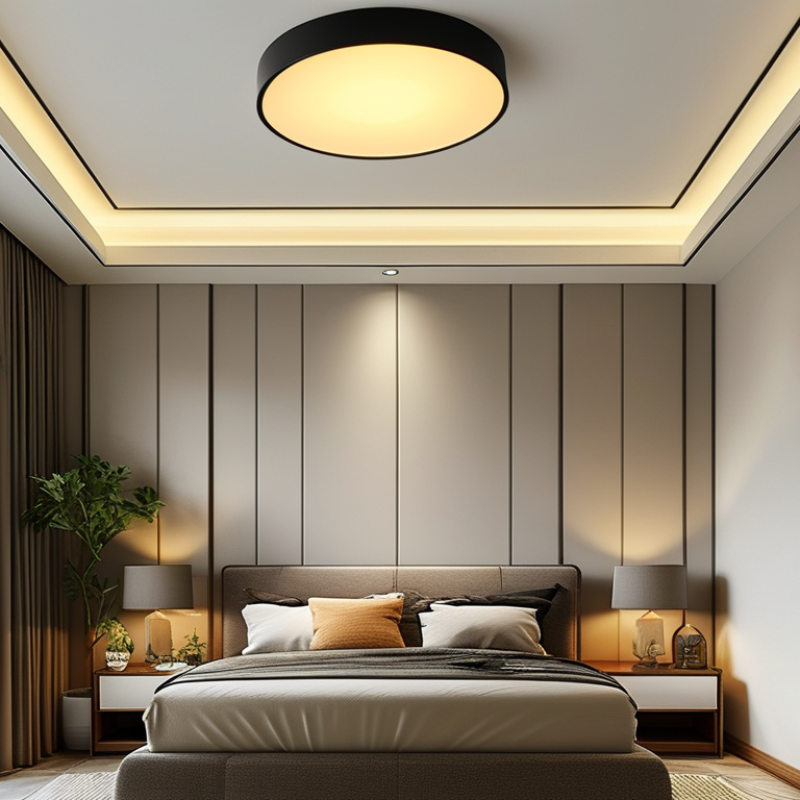
| Basic Indoor LED Surface Light | Powder-coated steel Polycarbonate diffuser
Steel provides a rigid mounting base, while polycarbonate offers good impact resistance and even light diffusion. | Typically 800–3,000 lumens
Approximately 90–130 lumens per watt
Common sizes: 300–600 mm diameter or length | 2,700–4,000 K
CRI 80 or higher
Opal diffuser for low-glare general lighting | Dry-location rating for ordinary interiors
IP20 is common where there is no water exposure
Class I or Class II electrical construction, depending on the design | On/off switching
Phase-cut dimming when the driver is specifically compatible | Bedrooms, living rooms, corridors, retail areas, and general commercial interiors | Check ceiling compatibility, driver replacement access, diffuser yellowing resistance, and whether the dimmer is listed for the fixture. |
| Bathroom and Moisture-Resistant Surface Light | Aluminum housing Sealed polycarbonate lens Silicone gasket
Aluminum helps dissipate heat; gaskets reduce the chance of moisture entering the enclosure. | Typically 1,000–3,500 lumens
Approximately 85–120 lumens per watt
Sealed construction may slightly reduce optical efficiency | 3,000–4,000 K
CRI 80 or higher
Wide beam distribution for uniform facial and room illumination | IP44 or higher for splash-prone areas
IP65 may be appropriate where water jets or heavy spray are possible
Use only within the manufacturer’s stated zone and installation position | Wall switch
Phase-cut dimming with a compatible driver
Occupancy or humidity sensor through a suitable control system | Bathrooms, laundry rooms, utility rooms, covered entrances, and damp corridors | Confirm the IP rating applies to the complete installed fixture, not only the housing. Inspect gasket compression and cable-entry sealing. |
| High-Impact Utility Surface Light | Die-cast aluminum Polycarbonate lens Stainless-steel hardware
Polycarbonate is generally more impact-resistant than glass and is suitable for demanding utility spaces. | Typically 2,000–8,000 lumens
Approximately 100–150 lumens per watt
Often available in linear or round formats | 4,000–5,000 K
CRI 80 or higher
Clear or prismatic lens for increased task visibility | IP65 or higher for dusty or wash-down environments
IK08 or higher where impact resistance is required
Select a temperature rating suitable for the installation area | On/off switching
0–10 V dimming
Microwave or passive-infrared occupancy sensing | Workshops, garages, storage areas, service rooms, and industrial corridors | Compare impact classification, operating temperature range, mounting strength, lens replacement availability, and ingress protection after installation. |
| Low-Glare Office Surface Panel | Aluminum frame Acrylic microprismatic diffuser Steel backplate
Microprismatic optics can control high-angle brightness more effectively than a basic opal diffuser. | Typically 2,500–5,000 lumens
Approximately 90–125 lumens per watt
Broad, evenly distributed light | 3,000–4,000 K
CRI 80 or higher
Low-glare optical design; verify the manufacturer’s glare data for the intended ceiling height | IP20 is generally sufficient for dry offices
Flicker performance should be checked for visual comfort and camera use
Use a suitable fire-rated ceiling fixing where required by local regulations | 0–10 V dimming
Digital addressable lighting control
Daylight and occupancy sensors | Offices, classrooms, libraries, meeting rooms, and computer work areas | Compare glare rating, flicker percentage, dimming range, standby power, acoustic performance, and compatibility with the building control system. |
| High-Color-Rendering Display Light | Extruded aluminum Optical-grade acrylic or glass Thermal interface material
A robust thermal path helps preserve LED performance and color stability over time. | Typically 1,500–4,500 lumens
Approximately 70–110 lumens per watt
Higher color quality can reduce total efficacy | 2,700–4,000 K
CRI 90 or higher
Consider R9 performance for red tones and color-sensitive merchandise | Dry-location rating unless a sealed version is specified
UV-resistant diffuser for areas exposed to sunlight
Verify photobiological safety information when used close to people | On/off switching
Phase-cut dimming
0–10 V or digital addressable dimming | Galleries, boutiques, salons, hospitality areas, and product display zones | Request full color data, including R9, color consistency, lumen maintenance, diffuser transmission, and the effect of dimming on color quality. |
| Tunable-White Surface Light | Aluminum heat sink Polycarbonate or acrylic diffuser Steel mounting plate
The housing should provide sufficient thermal management across the full color-temperature range. | Typically 1,500–5,000 lumens
Approximately 70–115 lumens per watt
Maximum output may vary by selected color temperature | Commonly adjustable from approximately 2,700–6,500 K
CRI 80 or higher; higher-quality versions may offer CRI 90
Useful for scene setting and daylight-oriented operation | IP20 for dry interiors unless a sealed model is specified
Check electromagnetic compatibility and radio-frequency requirements
Confirm safe operation at the selected dimming level | Wireless control
Digital addressable lighting control
0–10 V with a compatible tunable-white driver
Wall-mounted scene controller | Hospitality, healthcare, education, residential interiors, and multipurpose rooms | Compare control protocol, commissioning method, minimum dimming level, network security, power consumption at standby, and manual override options. |
| Emergency-Compatible Surface Light | Steel or aluminum body Polycarbonate diffuser Rechargeable battery enclosure
Battery ventilation, thermal separation, and service access are important for long-term reliability. | Normal operation commonly ranges from 1,000–4,000 lumens
Emergency output depends on the battery and emergency driver
Emergency duration is commonly 1–3 hours, subject to local requirements | Usually 3,000–4,000 K
CRI 80 or higher
Emergency illumination must be designed for the required escape-route or open-area coverage | Use a certified emergency-lighting design suitable for the jurisdiction
Check battery temperature rating and automatic test functionality
Maintain required clearance around the battery and driver | Maintained or non-maintained emergency operation
Central monitoring where supported
Automatic self-test and status indication | Escape routes, public buildings, apartments, offices, and commercial premises | Verify emergency duration, rated emergency lumens, battery replacement interval, test records, charge time, and the distinction between maintained and non-maintained operation. |
| Exterior Canopy and Covered-Outdoor Light | Powder-coated die-cast aluminum UV-stabilized polycarbonate lens Stainless-steel fasteners
UV-resistant materials and corrosion-resistant hardware are important for outdoor durability. | Typically 2,000–10,000 lumens
Approximately 90–140 lumens per watt
Output should be selected according to mounting height and target illuminance | 3,000–5,000 K
CRI 70 or higher for general outdoor utility lighting
Symmetric or asymmetric optics depending on the area layout | IP65 or higher for exposed installations
IK08 or higher where vandalism or accidental impact is possible
Corrosion resistance should match the local climate and salt exposure | Photocell control
Passive-infrared occupancy sensing
0–10 V dimming
Wireless scheduling or networked control | Parking structures, loading bays, covered walkways, service yards, and exterior entrances | Check surge protection, ambient-temperature range, corrosion testing, condensation management, photocell placement, and maintenance access. |


 Your message must be between 20-3,000 characters!