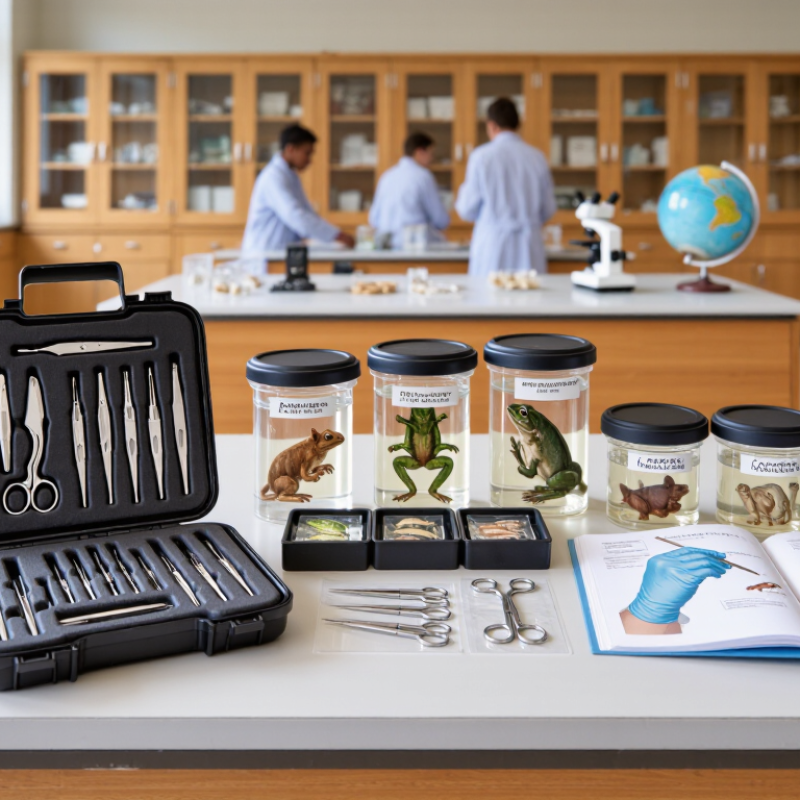
| Basic Classroom Kit | Introductory anatomy, plant biology and basic specimen handling | Straight scissors, standard forceps, blunt probe, teasing needle, scalpel handle and disposable blades | Martensitic stainless steel for cutting tools; austenitic stainless steel may be used for forceps and probes | Verify the declared steel grade against the applicable ASTM F899 stainless-steel classification; commonly used grades include 420 or 440A for cutting instruments | Stainless steel, subject to documented grade and composition | Reusable metal instruments may tolerate steam sterilization when the supplier validates the complete instrument; disposable blades are not reprocessed | Low acquisition cost, compact storage and clear separation between reusable instruments and disposable sharps |
| Secondary School Biology Kit | Routine dissection of preserved animal specimens and larger plant samples | Dissecting scissors, anatomical forceps, scalpel handle, probes, blunt-point seeker and specimen pins | 420 stainless steel is commonly selected for firm cutting edges; 304 or 316 stainless steel may be used for corrosion-resistant non-cutting parts | ASTM F899 should be used as a material-reference check rather than as evidence that the complete kit is certified | Stainless steels listed for surgical and dissecting instruments, with grade confirmation required from the technical file | Suitable for cleaning and repeated steam sterilization only where construction, finish and manufacturer instructions support it | Prioritize rounded handles, secure blade fitting, corrosion resistance and safe storage for classroom use |
| University Anatomy Kit | Undergraduate anatomy, zoology and comparative morphology laboratories | Scalpel handle, dissecting scissors, tissue forceps, hemostatic-style clamp, probes, rib spreader and ruler | 420 or 440A stainless steel for cutting edges; 304 or 316 stainless steel for corrosion-resistant components | Compare the supplier's grade, heat treatment and hardness information with the relevant ASTM F899 material designation | Stainless steel is the principal category; other materials must be separately declared where present | Reusable instruments can generally be designed for steam sterilization, but hinges and serrations require validated cleaning procedures | Look for replaceable blades, corrosion-resistant joints, etched identification and a complete cleaning instruction set |
| Advanced Comparative Anatomy Kit | Detailed dissection of vertebrate specimens, organs and connective tissues | Fine-point forceps, micro-scissors, spring scissors, sharp and blunt probes, retractors and precision scalpel handles | 440A or 440C stainless steel may be selected for higher edge retention; 316 stainless steel is often preferred for corrosion-sensitive non-cutting parts | Confirm whether the declared 440-series grade is supported by material certificates and whether cutting performance is appropriate for the intended task | Stainless steel; the standard's material framework should be checked against the exact alloy and instrument function | Steam sterilization may be appropriate for compatible reusable instruments; delicate springs and fine tips need careful inspection | Precision, tip alignment, hinge smoothness and replacement availability are more important than the number of included pieces |
| Field Biology and Teaching Kit | Field stations, specimen preparation, environmental education and mobile laboratories | Compact scissors, forceps, folding probe, scalpel handle, hand lens, sample spatula and labeled specimen tools | Corrosion-resistant stainless steel for instruments exposed to moisture; polymer cases and non-metal accessories should be identified separately | Request the exact stainless-steel designation and avoid treating a general “surgical stainless steel” statement as an ASTM F899 grade declaration | Stainless steel for reusable tools; polymer, glass or other materials should be documented independently | Field cleaning may be limited; use protected storage, prompt rinsing and sterilization or disinfection according to the specimen protocol | Choose lightweight cases, corrosion protection, secure sharps storage and tools that remain usable without laboratory infrastructure |
| Laboratory-Grade Reusable Kit | High-frequency teaching laboratories requiring repeated cleaning and instrument replacement | Full-size scissors, dissecting and tissue forceps, clamps, probes, retractors, scalpel handle, needle holder and instrument tray | Documented 420 or 440-series stainless steel for cutting instruments, with 304 or 316 stainless steel frequently used for corrosion-resistant components | Best suited to buyers requesting heat, corrosion and material documentation referencing the relevant ASTM F899 grade | Stainless steel material selection should be stated for each instrument category, not only for the kit as a whole | Designed for repeated cleaning and steam sterilization only when validated; passivation, drying and routine maintenance affect service life | Request lot traceability, material certificates, maintenance instructions, replacement parts and documented reprocessing compatibility |


 Your message must be between 20-3,000 characters!