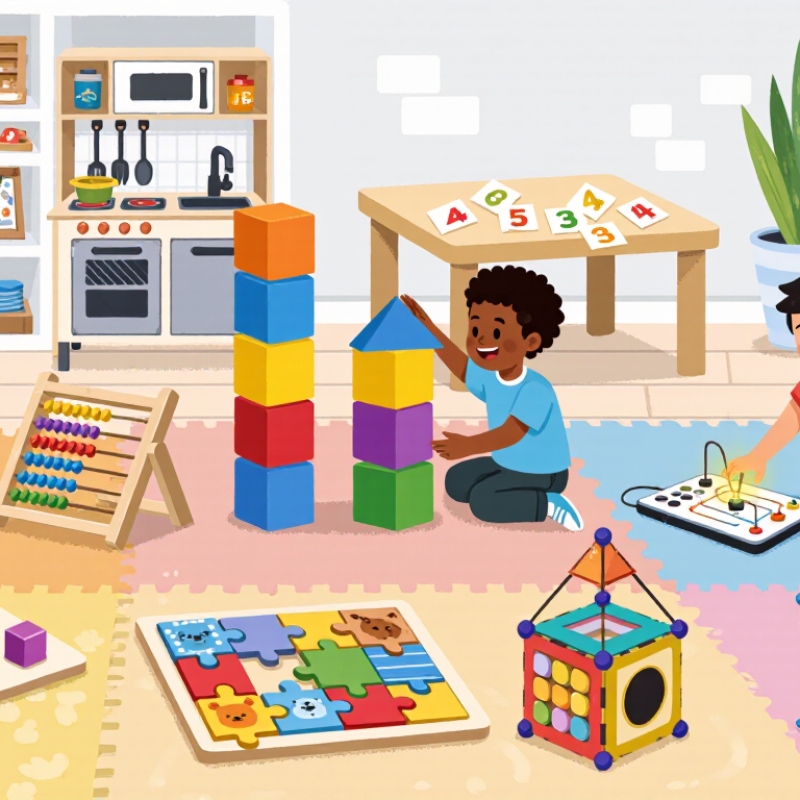
| Large building blocks | About 1–5 years; follow the package age guidance | Spatial reasoning, creativity, early problem-solving, and hand-eye coordination | For children under 3, choose pieces too large to swallow and avoid sets containing small accessories. Check for smooth edges and secure, non-flaking finishes. | Look for sturdy pieces that connect reliably and can be washed according to the care instructions. | Often offers strong long-term value because pieces can be reused for many kinds of open-ended play. |
| Simple shape and knob puzzles | About 1–4 years, depending on piece size and complexity | Shape recognition, visual matching, persistence, and fine motor skills | Check that pieces are appropriately sized for the child and have no splinters, sharp edges, or loose parts. Avoid small pieces for children under 3. | Thick pieces and a sturdy board are easier for young children to handle repeatedly. | Usually a good entry-level option; choose a difficulty level the child can grow into without making the puzzle frustrating. |
| Counting and sorting manipulatives | About 3–7 years; small pieces require close supervision | Counting, sorting, pattern recognition, early number concepts, and fine motor control | Many sets contain small pieces and are not suitable for children under 3. Store pieces securely and supervise children who still mouth objects. | Durable, washable pieces and a lidded storage container help reduce loss and keep the set usable. | Can provide good value when the same pieces support counting, sorting, pattern-making, and imaginative play. |
| Interlocking construction sets | Commonly 4 years and up; check the specific set’s age label | Planning, engineering concepts, spatial reasoning, and following instructions | Check for small parts and age warnings. Keep pieces away from young children who may swallow them. | Look for pieces that connect securely without excessive force and instructions that can be stored or accessed again. | Value improves when parts can be combined with other compatible pieces or used for free building after the model is complete. |
| Magnetic construction tiles | Often 3 years and up, but always follow the product’s age label | Geometry, symmetry, spatial reasoning, and creative design | Magnets can cause serious internal injuries if swallowed. Inspect tiles regularly for cracks, loose magnets, or damaged seams; keep damaged pieces away from children. | Choose tiles with securely enclosed magnets and smooth, sealed edges; replace any tile that cracks or opens. | Can be versatile for repeated building, but value depends on safe construction, piece count, and how often the child uses them. |
| Pretend-play kitchen or tool set | About 2–6 years; select pieces suited to the child’s age | Language, social interaction, role-play, and everyday problem-solving | Check for small accessories, sharp edges, pinch points, and cords or straps that could pose a hazard. Avoid small parts for children under 3. | Sturdy, easy-to-clean materials and replaceable or widely usable accessories can extend play life. | Often offers good play value when children can use household-safe props or create their own imaginative scenarios. |
| Beginner science and nature kit | Usually 5 years and up, with adult help as directed | Observation, asking questions, simple measurement, and early scientific reasoning | Read all age and supervision guidance. Check materials and experiment instructions; keep chemicals, small parts, and tools away from younger children. | Prefer reusable tools and clear instructions; check whether any consumable materials need replenishing. | Value is strongest when experiments use reusable equipment and everyday materials rather than a single-use activity. |
| Washable art materials | About 2 years and up, depending on the material and package label | Creativity, color recognition, hand control, and visual expression | Use materials labeled for the child’s age and intended use. Follow warnings, supervise young children, and do not assume “washable” means edible or non-toxic. | Durable, easy-to-clean tools and refillable supplies can reduce waste; store materials as directed to prevent drying out. | Can be an economical choice when supplies are replenishable and the child can use them for many projects. |
| Beginner musical instruments | About 2–7 years; instrument size and supervision needs vary | Listening, rhythm, coordination, sound exploration, and turn-taking | Check for loose parts, splinters, sharp edges, and detachable mouthpieces. Choose a suitable sound level and supervise instruments with small components. | Solid construction, secure joints, and materials that can be cleaned as directed help instruments withstand frequent use. | Simple instruments can offer lasting value through open-ended play and group activities. |
| Cooperative and matching board games | Often 3 years and up; confirm the age label and small-piece warnings | Memory, turn-taking, matching, counting, communication, and following rules | Check the size of cards, counters, and tokens; keep small pieces away from children under 3. Supervise younger players as needed. | Thick cards, sturdy boards, and a complete, easy-to-store set are more likely to last through repeated play. | Can provide strong shared-play value, especially when the rules can be adjusted for different skill levels. |


 Your message must be between 20-3,000 characters!